Fixing the Front Seven: Bucs’ NFL Draft Priorities 1 and 2
The Bucs are in a bit of a pickle. For one, their head coach is on the hot seat, perhaps the hottest in the league. Their general manager, who is largely regarded as one of the top tier talent-wranglers in the league, has mostly sat on his hands this offseason so far. After all, the splash deal hasn’t been Jason Licht’s Modus Operandi outside of Tom Brady, who brought Rob Gronkowski and Antonio Brown with him. Over the last few years, outside of Baker Mayfield, none of their free agents have been anywhere near a resounding success.
Sure, maybe part of this is allocating cap space and cash towards re-signing and extending their successful draft picks. But 99% of their “outside hires” have been swings and misses since 2021. Not to mention their apparent lack of ability to develop their top-100 defensive draft picks in that span. Throw in the metaphorical cherries on top of losing not one but two of your franchise’s all-time greats, two of the longest tenured players in the history of the team and the defining faces of the last decade plus on each side of the ball…
Things are looking bleak, to say the least.
With that being said, the Draft is coming up in just a few short days now, where the Bucs will inevitably make seven perfect selections and blow every fans mind by bringing in a record shattering seven all-pros in the same draft.
Before we get to the ever-exciting and definitely not over-saturated mock-drafting, let’s look at the net gains and losses this offseason.
Gains:
LB Alex Anzalone (DET)
QB Jake Browning (CIN)
RB Kenneth Gainwell (PIT)
S Miles Killebrew (PIT)
OLB Al-Quadin Muhammad (DET)
DL A’Shawn Robinson (CAR)
LB Christian Rozeboom (CAR)
OT Justin Skule (MIN)
DT Rakeem Nuñez-Roches (NYG)
WR David Sills V (ATL)
Retentions:
G Dan Feeney
TE Ko Kieft
TE Cade Otton
RB Sean Tucker
Losses:
QB Teddy Bridgewater (DET)
CB Jamel Dean (PIT)
WR Mike Evans (SF)
DL Logan Hall (HOU)
T Charlie Heck (MIA)
S Christian Izien (DET)
RB Rachaad White (WAS)
LB Lavonte David (RETIREMENT)
Jake Browning was among the best backups in the league in 2023, and certainly took a step back this last season, but he’ll be an immediate upgrade over Teddy Bridgewater, who looked uninterested in winning against the LA Rams in his only appearance this season.
Kenneth Gainwell was fifth among all running backs in receiving yards, trailing only Christian McCaffrey, Bijan Robinson, Jahmyr Gibbs, and De’Von Achane. He was also fourth in catches among running backs and fifth in receiving touchdowns. He’ll be an upgrade over Rachaad White as receiver, but a downgrade as a pass blocker.
Gainwell’s fit next to Irving and Tucker is also questionable, as they don’t have a big bodied power back on the roster (Irving – 5’10” 195lbs, Tucker – 5’10” 205lbs – Gainwell 5’9” 200lbs, while White was – 6’0” 214lbs) and probably won’t carry a fourth running back into the season.
Anzalone figures to be the replacement starter and is admittedly an upgrade over the now-retired and future Gold Jacket Lavonte David at this stage of his career. The main question will be who they can manage to pair him with that’s not named SirVocea Dennis.
Christian Rozeboom and Miles Killebrew will both figure as special teams players, as Killebrew was the AFC All-Pro special teamer, and Rozeboom’s primary role in Carolina was special teams as well. This is a position group desperate for SOMETHING, and legendary Special Teams Coach Danny Smith, who they picked out of the vaguely Mike Tomlin-shaped crater in Pittsburgh, is bringing in players to work in his system.
A’Shawn Robinson is an immediate upgrade over Logan Hall as their five-technique, as he’s extremely skilled in the run and on about the same level as a pass rusher.
Al-Quadin Muhammad is a fine pass rusher to rotate in as a pass rush specialist, and he’ll probably get as many or more snaps than Anthony Nelson and Chris Braswell as the third edge rusher, hopefully behind whoever replaces Haason Reddick.
Looking at the roster after these given changes, the positional needs look something like this:
1a) EDGE
1b) LB
3) S
4) CB
5) IOL
6) NT
7) WR
Edge and Linebacker have been two gaping holes since 2022. It’s an indictment on the front office that they’ve failed to properly address either of these positions in free agency or the draft, and a travesty that the coaching staff has failed to develop drafted talents on the front seven since they got here. Even going back to 2019, Devin White (5th overall), Joe Tryon-Shoyinka (32nd overall), K.J. Britt (5th round), Logan Hall (33rd overall), SirVocea Dennis (5th round), and Chris Braswell (57 overall), have all seemingly busted or flamed out.
While sure, expectations should have been lower for Dennis and Britt, they certainly haven’t been starter-worthy players that have started the majority of seasons next to Lavonte David. Poor 54 had one decent season of Devin White (who couldn’t cover a traffic cone) but didn’t play next to one competent linebacker after Kwon Alexander skipped town, and even Kwon couldn’t tackle.
Edge rusher is the most important position on defense. It’s the third most important position on the field behind Quarterback and Left Tackle. Having a competent pass rush makes or breaks a defense. The ‘85 Bears had 64 sacks led by Richard Dent (17), Otis Wilson (10.5), and Steve McMichael (8). The ‘91 Eagles had 55 sacks, with Reggie White and Clyde Simmons combining for 28. In 2002, Sapp and Rice combined for 23 in the regular season, and the team had 11 in the playoffs. From 2019 to 2020, Jason Pierre-Paul and Shaq Barrett combined for 54 sacks, and that’s not counting the contributions of Devin White (11.5), Ndamokung Suh (8.5), Vita Vea (4.5), and Carl Nassib (6.0) over that same span.
With that being said, it has to be one of the first two picks they make, whether that means trading back to get better value, staying put and taking whichever one falls, or trading up for a top tier talent.
With as many holes as they have, trading up is not a great move no matter who it’s for. And staying put is not going to land them an impact edge rush player worthy of 15th overall.
EDGE Rankings (Graded on first round value):
- Arvell Reese A+
- David Bailey A
- Reuben Bain Jr. A-
- Cashius Howell B
- R Mason Thomas B-
- Malachi Lawrence B-
- Akheem Mesidor C+
- Zion Young C
- T.J. Parker C-
- Keldric Faulk D-
This is not a deep class by any means. Reese, Bailey, and Bain are all consensus top 10 picks, and there’s a high possibility they all go in the top five.
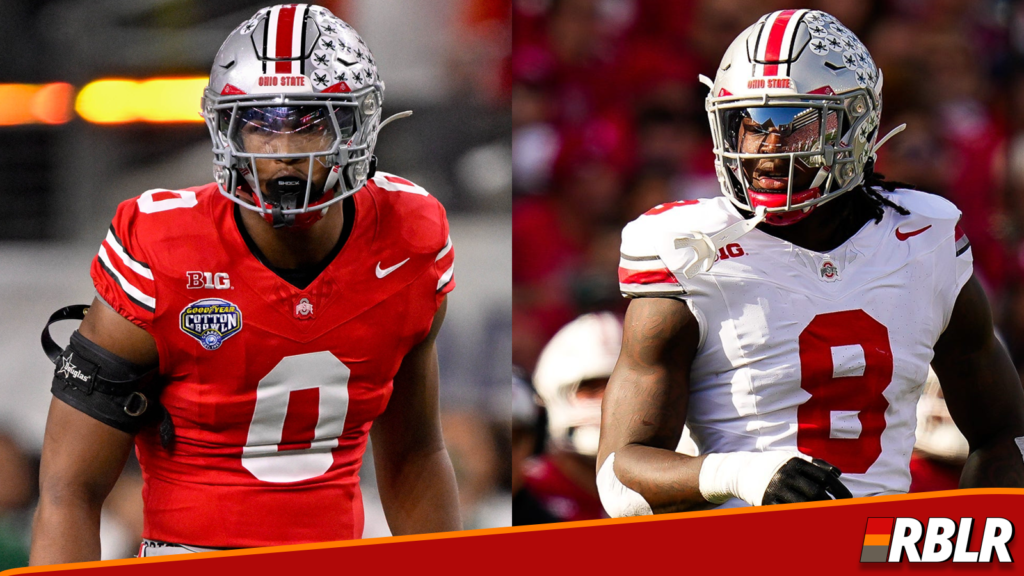
Though Arvell Reese (OSU) projects as a bit of a hybrid LB/EDGE, he’s got the rare speed and bend combo to absolutely wreak havoc as a pass rusher and run defender. The ceiling is Micah Parsons, and he should be the most impactful first year defender in this class, especially in a system that lets him play to his versatility as a hybrid edge.
David Bailey (TTU) is a purer and more polished pass rusher than Reese, and his production backs that up. 14.5 Sacks, 19.5 TFLs, 3 forced fumbles and 3 pass breakups. Unfortunately his run defense isn’t nearly as elite as his first step. No doubt in my mind that he’s the best pass rusher, but his run defense could keep him off the field on some early downs.
Reuben Bain Jr. (UM) is shorter and heavier than his counterparts in this class, and his arms are some of the shortest ever recorded (30 ⅞”). But he was an absolute wrecking ball at Miami, and combining his power with his agility, he’s a versatile pass rusher that’s a few pounds away from lining up at 3-technique. His pro comparison in terms of build is Calijah Kancey, who also came into the draft with very short arms, though Bain’s about 15 pounds lighter, but their aggressively pass rush focused mindsets and flexibility on the defensive line are very much comparable.
One would be justified in saying that the 15th overall pick is more valuable than the next seven names on this list. None of the above players are likely to fall even with Bain’s recently resurfaced off-field concerns.
Cashius Howell (TAMU) was an elite pass rusher in college. He’s got maybe the best first step in the whole class. But much like Thomas, he’s terribly undersized, and he has the third shortest arms in Combine history (why is this a running theme?). He’ll be a great pass rush specialist in the NFL, but his arm length is gonna prevent him from keeping his distance from OTs, and it’ll keep him from being any kind of contributor against the run. His 40-yard dash time is nothing to scoff at, and could make him a top 20 pick, but he’s by no means a complete prospect. If he can get coached up on setting the edge and anchoring himself in the run game, and hopefully put on some muscle, he could be a 10-sack per year guy down the line, but he’ll have to be able to stay on the field.
R Mason Thomas (OU) was an absolute game wrecker with a 14.6% pressure rate and 6.5 sacks in just 10 games in his senior season at Oklahoma. He’s got an incredible motor. A scrappy player, Thomas’ calling card is his speed and bend, but believe that he converts his speed to power violently. Unfortunately, he’s tremendously undersized at 6’2” 241lbs, and none of his size measurements get above the 20th percentile. He’s also been extremely injury prone with ankle injuries (in both ankles) limiting him in his first two seasons (both of which required surgery), and he missed a sizable chunk of his senior year with quadricep and hamstring injuries.
Malachi Lawrence from UCF has gone under the radar on many lists, but he truly has the potential to be NASTY at the next level. He doesn’t have any of the size concerns that some previous prospects have, and he has all the same athleticism, including a 4.52 40 yard dash, a 40 inch vertical, and a 130 inch broad jump, which figures out to a 9.94 RAS (Relative Athletic Score), which places his overall athleticism in the 99th percentile of defensive ends in NFL Combine history. He’ll come into the NFL as a complete pass rusher with all the chops, rips, swipes, and counters you could ask for. But he simply cannot defend the run, much like the other second-tier guys at edge rusher in this class.
Akheem Mesidor (UM) is fine. I’m sure he’ll be an ok NFL player. But his ceiling simply can’t be that high. Outside of the foot surgeries, he just turned 25. Sure, maybe he could continue to develop in the NFL, but at that age, most NFL players are a finished product. Late bloomers are exceptionally rare. He was absolutely dominant last season at Miami, and he’s certainly got a deep pass rush bag. However, of his 12.5 sacks, comparatively few were wins to the “High” side, outside of the Tackle, and a disproportionate amount came as he looped back inside.
Miami’s defensive line in general was incredible last year with Reuben Bain Jr. and above average play from Ahmad Moten as well. Plenty of Miami’s sacks last year were reps where everyone beat their blocker (otherwise known as the “Everybody Meet At The QB” play, one that Todd Bowles mysteriously omits from his play sheet).
That’s not a knock on Mesidor, but an assertion that he actually could have had more sacks on the statsheet if he wasn’t sharing so many as half-sacks.
He’s probably the most mocked player to Tampa Bay at the 15th pick, but I just don’t see it. He beat up on college players the way you would expect a 24-almost-25-year-old to do. Sure, he could end up being good in the NFL, but even if he is (which is not a guarantee by any stretch), he’d be on your roster for a limited time and end his rookie contract at 29 or 30 years old. In short, his floor is as high as the top tier players at the position in this draft, but his ceiling is very limited.
Zion Young (MIZZ) is a much more prototypical edge rusher in terms of frame, standing 6’6” with a more average wingspan than others in this physically diminutive draft class. However, he lacks the explosive traits and first steps of players ranked ahead of him. For this reason, he’s a better fit in a 4-3 defensive scheme as an everydown true defensive end, as opposed to a pass rush specialist in a 3-4 scheme. He also has a number of off-field concerns, including a misdemeanor assault charge and a pending DWI charge from just five months ago, which is concerning. But he did visit with the Bucs before the draft, and for good reason. He’s a physical, feisty player who plays through the whistle, and he has all the hustle and energy to finish plays even across the field. He’ll likely be more of a second round option, but he’ll be on the Bucs board when they pick at 46th overall.
TJ Parker (CLEM) is another prototypical 4-3 defensive lineman at least in terms of skillset, but he’d be undersized for the job. Despite a fairly impressive 4.68 40-yard dash, his first step is not great, and he struggles to turn the corner on tackles. His pass rush bag is limited, but not a deal breaker, because the right landing spot can easily develop that part of his game. He was also a decent pass defender, and one could be curious to see how that would play out in a Bowles-like scheme, as he infamously enjoys a good firezone blitz (dropping off a dedicated pass rusher to fill the zone of a blitzing linebacker or defensive back).
He’s got great run defense instincts when it comes to getting into the backfield, but he doesn’t have a high motor in the run game, and often gives up on plays that go away from his side or gap. He also doesn’t wrap up ball carriers in the open field, opting instead to swipe for the ball (which is admittedly, something he’s among the best at).
Keldric Faulk (AUB) is a curious case. He’s a true defensive end in stature (6’6”, 276lbs, 84in wingspan), and he is very clearly the best edge defender against the run in this draft. In fact, he could very well be a first round pick on that skillset alone. He’ll be freshly 21 years old when the season starts, and he certainly has a ton of raw potential. But his pass rush skills are… well… raw. He doesn’t have much bend, or arc to his rush game, his first step is inconsistent at best, and his hands need adjustment. That being said, his alignments are versatile, ranging from a 3-technique (think Gerald McCoy, Ndamukong Suh) to a 5-technique (J.J. Watt, Michael Bennett).
He’s got all the traits and a powerful motor, and it’ll be fun to watch what he can develop into in the NFL. But the Bucs can’t seem to develop pass rushers, and they shouldn’t be entrusted with this one. But with the Bucs fans’ luck and how much Bowles and Co. prioritize the run game, don’t be surprised if he’s under consideration at 15th overall.
The second biggest need for the Bucs this offseason is off-ball linebacker. While the addition of Alex Anzalone is impactful, the Bucs have honestly not hit on a linebacker pick in 14 years. Devin White, Kwon Alexander, and Kendall Beckwith all showed some promise but didn’t work out in Tampa long term. And then you have fifth rounders like SirVocea Dennis and K.J. Britt who were thrust into starting roles far before they were ready. The result has been Lavonte David coping with a gaping hole on the field next to him for virtually his entire career.
While edge rush is a borderline necessity in round 1, LB is right there with it. Frankly, the Bucs could go LB in round 1 and Edge in round 2 for the right prospect. These are the prospects worth taking in the first two rounds with their prospective fit grades:
Sonny Styles A+
Anthony Hill Jr. B+
Jacob Rodriguez B
CJ Allen C-
Sonny Styles (OSU) might end up the best player in this draft class when it’s all said and done. Styles is a legitimate freak athlete, with a Relative Athletic score of 10.00, placing his combo of size, speed, agility, and strength as the highest of any combine-measured off-ball Linebacker ever. At 6’5”, 244lbs, his frame is among the most impressive in recent history, comparable to players like Tremaine Edmunds and Luke Kuechly. Throw in his 4.46 40-yard dash and a 43.5 inch vertical (!!!), and he could absolutely be one of the best linebacker prospects ever. The tape tells the same story. He covers ground easily from sideline to sideline, and he matched up very well with both Tight Ends and Running Backs.
As a former safety, his zone coverage is incredibly instinctual as well, and he doesn’t miss tackles (only two in 2025), which could be expected at his size. Another positive is that he doesn’t have to rely on a “low man wins” mentality in the run game when it comes to getting off his blocker, as he quite often has the speed and agility to get around blockers instead. Is he perfectly polished? No. He definitely still needs some development in the run game, and the play action that comes from it, but he was the Green Dot Linebacker at a premier college program last year and he’s only been playing linebacker in college for two years. Unfortunately he will likely be a top 10 pick if not top 5, as he was already marked for top 15 before his historic combine.
Anthony Hill Jr. (UT) would be a great fit for the Bucs. He’s scheme-versatile, helpful not just because of the complexity of Bowles defense, but who knows what the defensive scheme could be in 2027? Hill has the motor and energy to stay on the field the whole game, which is only half a joke. He also has a very well-rounded skillset in every facet of the game. His 17.0 sacks across 2 seasons and then a partial junior year, 90.0 tackle grade according to PFF, 31 tackles for loss, and he allowed a 62.6 passer rating when he was targeted, including 2 interceptions and no touchdowns in 10 games this last year. He does have trouble matching up with running backs in man coverage, and he definitely struggles to get off blockers in the run game, especially if his over aggression takes him past the play. But neither of those are deal breakers. His broken hand to end his junior year (which he played through for a week), is not particularly concerning, but his hamstring strain that kept him out of the field drills at the combine may raise eyebrows. He’ll definitely be on the board when the Bucs are scheduled to pick in round 2, and he may even fall to round 3.
Jacob Rodriguez (TTU) was a two way player in high school, and committed to Virginia as a freshman to play Quarterback. He then transferred to Texas Tech to play with his older brother after Bronco Mendenhall resigned. The coaching staff converted him to a full time linebacker where his career has taken off. After being a first team All Big-12 in 2024, he took home just about every award he could in 2025: unanimous All-American, Big 12 DPOY, the Bednarik, the Butkus, the Nagurski, and the Lombardi awards. He’s not just a cool story though. Rodriguez sees the game through a Quarterbacks eyes, and his processing and Football IQ are off the charts for a college player. He fits the run and diagnoses route combos at an exceptional level. He absolutely gets too aggressive in the run game, and gets exposed in Counter concepts as well as play action on occasion. He also tends to get burnt vertically, but these are all very fixable issues in the film room. Rodriguez figures to be a second round pick, and should absolutely be in a Bucs uniform next year at that price.
CJ Allen (UGA) is one of the players most commonly mocked to the Bucs at 15. It makes sense. He fits the profile of what the Bucs defense wants to be: He’s an elite run defender (by far the best from the position in this class), and he’s a defensive captain from a blue chip program projected to go in the first round. He also really struggles in coverage. Sound familiar? He showed real improvement from 2024 to 2025, but he still gave up a passer rating of 104.1, giving up 2 touchdowns and only forcing three incompletions according to PFF. We’ve seen this play out before with the Bucs. The modern NFL calls for linebackers to be able to stack guards and hit the hole in the run game, play their zones over the middle without getting exposed by play action, and cover both Tight Ends and Running Backs. If a player can’t do all of these effectively, they won’t pan out. CJ Allen cannot be the first round pick at least at 15th overall, and he won’t fall to the second.
These are really the only options that fit their needs at a high enough level to be a consistent playmaker on the field. I’m not sure many Bucs fans could stand to watch another season of sub-par linebacker play out of a Linebacker like SirVocea Dennis, who was very nearly dead last in PFF grade last year.