RBLR Rays Weekly Roundtable – 9/7/26 – Trade Past, Playoff Future
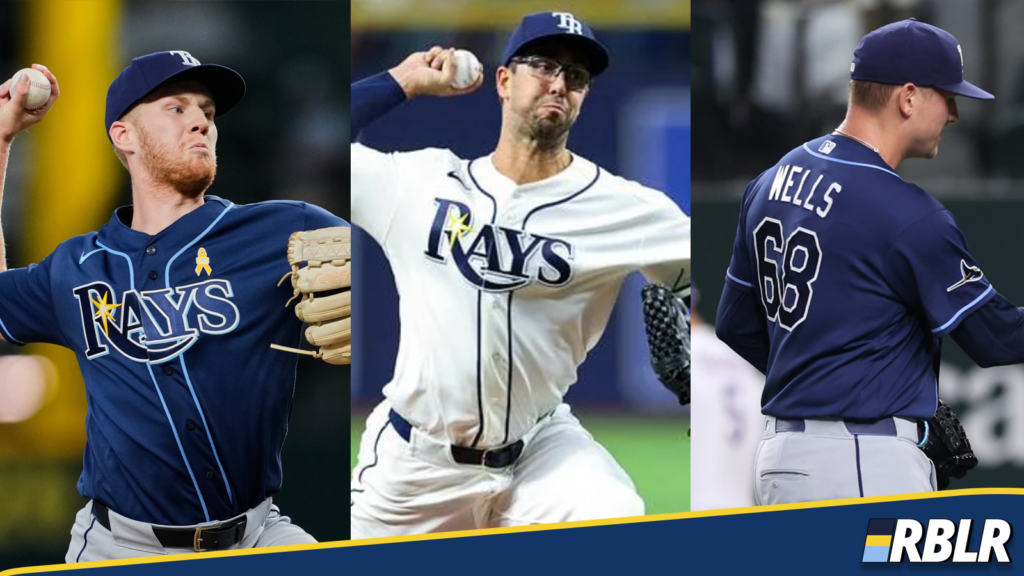
With less than 20 games left and a division to lock down, the Rays are turning to the details — who gets the call-up, who makes the postseason staff, and whether a two-year-old trade is finally starting to show its shape. It’s the kind of stretch where roster construction matters as much as the standings, and the roundtable’s got opinions on all of it.
Jacob Macauley (@raysfarmreport) : Interesting Call-ups
The Rays are entering the last month of the regular season, controlling their own destiny within the division, and have a compelling final 19 games to go. Likely, the Rays call-up options consisted of activating right-handed pitcher Griffin Jax and outfielder Victor Mesa Jr, but two candidates in particular interest me if the Rays want to go in a different direction.
Two prized prospects acquired at the 2024 trading deadline, Ty Johnson and Brody Hopkins, are both Rule 5-eligible this winter and have made midseason transitions to the bullpen. Hopkins has had a difficult adjustment to the major league baseball so far, walking an International League-high 21.9% of batters this season (min 80 IP). Granted, it’s only been 4 IP, but Hopkins has slashed his BB% down to 16.7% and raised his K% in the process to 33.3% in his brief relief stint. Brody’s stuff has played considerably up in relief, averaging out over 100 MPH on his fastball with 16 inches of ride from a low slot and a short, hard-breaking ball that gets 26 inches of vertical separation off his fastball that he throws at 89 mph.
Of the two, Ty Johnson has been far more productive this season as he has posted a 25.5% K-BB% this season, which is good for 2nd in the IL for pitchers over 60 IP this season. Johnson has made nine appearances in relief this season, and the results have been dazzling, inducing a 44.7% K% and 1.17 FIP in relief this season. Johnson gets it done with two pitches: a mid-90s fastball that gets good carry from a low slot and a short, hard breaking ball that has gotten a ton of miss this season.
Both provide interesting ceiling-raising options for a Rays bullpen that could use an impactful relief piece down the stretch. They will both need 40-man space to be promoted, which makes this a little more complicated, but I believe it’s worth giving at least one of these arms a look down the stretch.
Cory Ketchum (u/FLBoy19) : Building A Playoff Stable
MLB postseason roster rules differ from the regular season, however teams are still limited to only 13 pitchers on their 26-man roster. Rosters are set before each series, and while teams can pull from the 40-man roster due to injury, commissioner approval is needed to replace a player during a series. The main caveat is that only players on the 40-man roster at the start of September can be added to the active roster.
With how taxed pitching staffs get during the postseason, teams generally carry the maximum 13 pitchers. That usually includes five starters, with four handling most starts and the fifth serving as a bulk-innings or swing option. The final eight are generally a mix of high-leverage and multi-inning relievers.
Let’s start with the starters, where Shane McClanahan’s status creates some uncertainty. With the Rays announcing Shane is on an innings count, his injury can be viewed two ways. It could be a phantom IL stint to keep his innings down for October—which, if so, they could have picked something better than forearm tightness—or a general fatigue issue. Considering we haven’t gotten any MRI news, things sound fine. Assuming Mac is good to go, a starting four of Drew, Mac, Martinez, and Peralta is one of the better groups in the postseason. This allows Ian Seymour to move into a role more suited to his talent, maximizing his stuff in two- to three-inning assignments. Griffin Jax could also serve as a swingman capable of eating innings.
That leaves seven bullpen spots. Bryan Baker gives you a shutdown, high-leverage reliever who can work the ninth or other key situations. Baker has a 2.20 and 2.23 FIP in medium- and high-leverage situations, respectively, compared with a 5.05 FIP in low leverage. He has also been a true fireman, posting a 1.51 FIP with men in scoring position. Kevin Kelly has also been solid in leverage situations despite some bad luck with home runs. Half of his allowed home runs have come in those spots, inflating his FIP. His xFIP sits at 3.17 and 3.04 in medium- and high-leverage situations, respectively, while he has a 3.25 FIP and 3.28 xFIP with men in scoring position.
With five spots left, Tyler Wells slides into that A bullpen group. His starter’s mix and excellent command allow him to effectively mix pitches. Wells doesn’t have the pure stuff of some others, but he’s an above-average reliever. Garrett Cleavinger hopefully joins him, although his recent issues and IL placement make his availability uncertain. The same is true of Manuel Rodríguez. Both would be major additions to the Rays’ postseason bullpen if healthy.
Cam Booser has been phenomenal this year as a high-stuff left-handed option. In limited high-leverage work, he has a 1.17 FIP and a 0.10 FIP with men in scoring position. However, 21 of his 34.2 innings have come in low-leverage situations. Casey Legumina is a weird reliever. He has only a 17.8% strikeout rate, but pairs it with a minuscule 5.9% walk rate and a 6.3% HR/FB rate, 29th-best among relievers with at least 50 innings. Oddly also has above average pure stuff, but fails to capitalize on it. All the same hopefully Legumina will not be deployed outside of mop up scenarios, due to his inability strike batters out. If Manuel Rodríguez and Cleavinger are available and with Ty Johnson’s call up we could see injury petition from the Rays to allow him to play in the postseason (his first run in the majors will be important to track), the Rays have an argument as one of the best staffs going into the playoffs.
Carter Brantley (@ctbrantley12) : Revisiting the Jeffrey Springs Deal
Rays Received:
Joe Boyle, Will Simpson, Jacob Watters, Brendan Summerhill (via competitive balance pick)
Athletics Received:
Jeffrey Springs, Jacob Lopez
Winner:
Incomplete (but leaning Rays)
Phew, that turned out to be a bigger deal than I remember!
Most folks think of this as the “Springs for Boyle” deal, and ironically enough, both of those guys have probably had the worst time since being dealt.
Springs was fine last year, especially considering the atrocious nature of pitching in Sacramento.
But this season, he has a legitimate case for being one of the worst pitchers in baseball, even factoring in the park effects of playing in a minor league stadium.
He’s actually outperformed his baseline production if you’re a big believer in judging a guy by his FIP, whiff rate, and expected stats. This is impressive; his near-5.00 ERA is surpassed by his 6.28 FIP and 17th percentile xERA.
Springs has been bad. How has Boyle pitched?
Um… not great either. Unfortunately the massive righty still hasn’t quite gotten the hang of throwing strikes, and when he has he’s been giving up slightly below-average quality of contact marks.
He has to figure out one or the other; sure, his base production is inflated by a ridiculous near-.400 BABIP, and it’s also only been 56.2 innings in 2026.
That still doesn’t mean he’s been good, but the good news is he’s still got that massive upside with his velocity and gross slider. He’s already 27, but that doesn’t mean much. He could be very good as a late bloomer.
As for the rest of the return for both sides, Jacob Lopez has been a near-average starter in his time with the Athletics. So that’s been a win for the A’s, even if it hasn’t translated to many on- field wins, especially in 2026.
The Rays’ side of the “rest of this deal” has been interesting:
- Will Simpson is in Montgomery for his age 25 season as a power-over-contact right handed hitting first baseman with a 35+ projected future value on FanGraphs.
- Jacob Watters is a righty pitcher, also in Double-A, who’s been on the 60-day IL all of 2026.
- Brendan Summerhill is suited up for the Hot Rods, and he’s a good runner with a bit of upside in terms of both his hit and power. He’s played the majority of his games in center, and we’ll see if he sticks there.
Of the 3 mentioned above, Summerhill has the most upside, as he could be a solid all-around contributor as a 4th outfielder. His good speed gives credence to the notion of his ability to stick in center, but it’s still early, as he’s still only 22.
So, with all of this being said, it’s still too early to say who won this deal. While that’s a boring answer that won’t get me any hot take awards, it’s true. The Rays look poised to pull ahead in the coming years as Summerhill progresses and Boyle hopefully figures out how to fill up the zone.
But neither of those things are a given, so who knows?
The RBLR Rays Roundtable is a weekly collection of analysis, insight, and perspectives from a cast of writers assembled because of their unique backgrounds and experience. Check this space weekly for new updates and features covering the Tampa Bay Rays, the Rays’ minor league prospects, and more!