What Happens When a Referee Doesn’t Hear the Racism?
I want to start off this article with a little bit of context for a broader discussion that I hope can come about afterwards. This past weekend, the second round of US Open Cup qualifiers took place all over the country, with Pinellas County United hosting Kissimmee SC for a berth in the next phase. This will not be a full recap of the game; that is available on the competition website for those who are interested.
However, an incident occurred which brought up a topic that appears all the time in soccer: what happens with possible racism on the field?
The visitors from Kissimmee started the game well. They scored first and, after conceding a goal to make it 1-1, then scored the third and fourth goals of the game. With 15 minutes left, they were up 3-1, looking like they could win the match. Pinellas made it 3-2 before the game turned downright ugly.
One Kissimmee player was sent off for a second yellow, while a second player got a straight red card for a crunching challenge in stoppage time. A difference in maturity would have likely seen them win. Losing two players when there’s only a goal separating the game is obviously ill-advised. PCU scored with nearly the last touch of regulation, while more yellows flew from the ref’s hands.
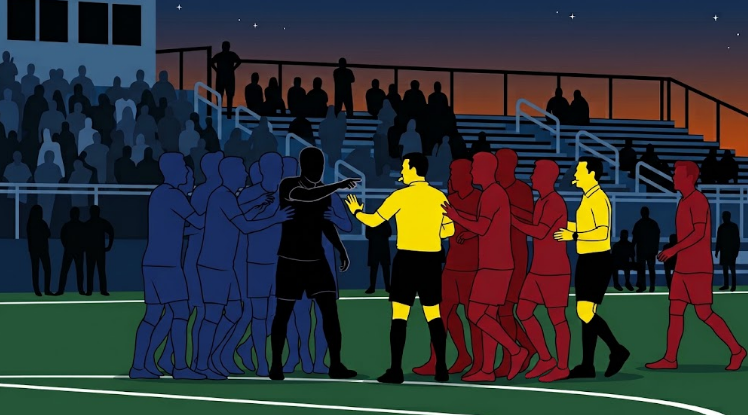
Before the extra time period could begin, though, the beginnings of a brawl started on the field. It came out that a home player accused one of the visitors of racism, and the referees had not heard the exchange themselves. They had to go through their protocol, which involved interviewing the captain and player involved from Pinellas as well as the captain and player involved from Kissimmee. Nothing came of this process, which is not to say the referees didn’t do all they could. It’s just that the fact of the matter is, without hearing it directly or corroborating evidence from recordings, that this is a he said, he said moment. You cannot act on the allegations alone when there isn’t something more for the center ref to use.
What could have prevented this? In the middle of the chaos during which racist language was alleged to have been used, it’s impossible for four referees to be everywhere they need to be. More microphones could certainly help. However, that is not a complete cure. Ahead of the recent men’s World Cup, Benfica’s Gianluca Prestianni supposedly used racist language in a match against Real Madrid. All the microphones on the side of the pitch at a UEFA Champions League game weren’t enough to pick that up, not least because – whatever he said – Prestianni covered his mouth. This led to a rule at the World Cup itself that players who cover their mouths while talking to opponents should be sent off without question.
In the lower levels of American soccer, the resources present are not on a similar level. You can’t rely on replays of players hiding their insults or microphones being placed everywhere anyway. So what is there to be done? This is a genuine appeal for suggestions, because this writer does not have an answer.
Pinellas stated at one point they would leave the field in protest if the opposition player did not get sent off. Kissimmee denied the accusation, forcing the referee to continue with the game. Ultimately, the affected player for PCU requested to be subbed, and they went on to win the match 4-3 in extra time after multiple further delays.
There is a sad truth that some number of people in the world not only identify with racist ideas, but would act on them, up to and including using vile language directed at other individuals. No wonder the Pinellas player would rather be subbed off: this isn’t a lack of maturity; this is a lack of respect, a lack of seeing someone as equal.
Kissimmee would likely still deny it took place; but, it cannot be argued that this never happens in the sport. If we cannot expect to fully change the minds of every single person playing soccer, then we must certainly be prepared to take action when needed.
What that looks like in a practical sense, who can say? Some amount of self-accountability would be preferable, if not the outright eradication of racism itself. The referees in this match did what they could with the resources and protocols they have. Ultimately, more leeway may be needed in specific instances like this so they can act with more force. If a player thinks they can get away with something, we know that many will try. If they’re trying to get away with racism, though, it shouldn’t be the same as doing a little dive or asking for a penalty.
Truly ending this behavior requires something we’re not doing. I hope we can come up with it so that someday we can say on-field incidents are a thing of the past.