RBLR Rays Roundtable – 5/25/26
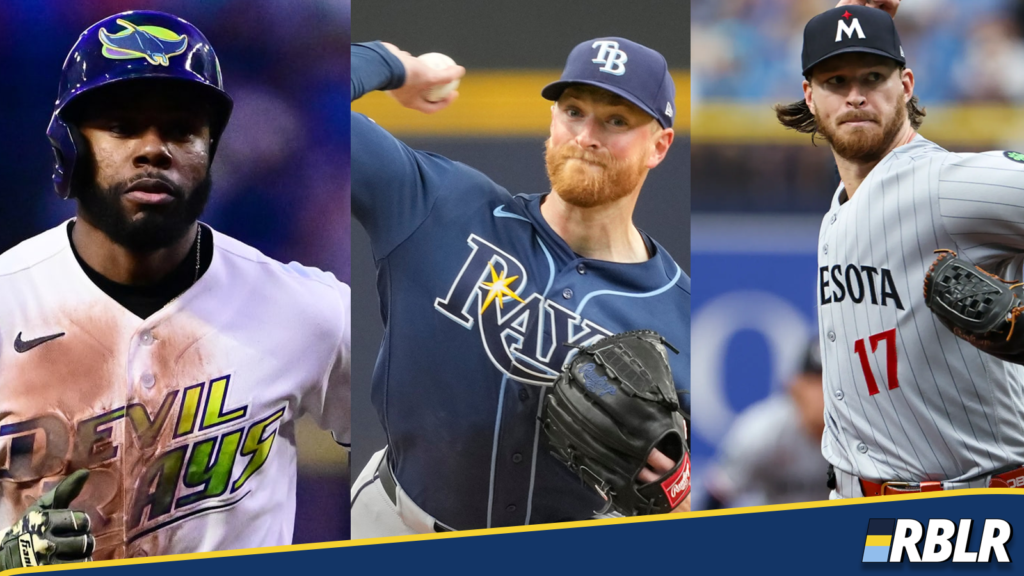
If you’ve been riding out this season with us, you already know that keeping a firm grip on the AL East requires constant calibration rather than comfortable complacency. This week, we are looking closely at the friction that underpins a sustained winning streak, diving into unexpected player transformations alongside the long-term strategic depth necessary to survive the summer grind.
Cory Ketchum (u/FLBoy19) : A Legacy Steal?
2025 was an odd year for the Rays organization. The MLB team played in a minor league ballpark, and the farm system saw a near-complete regression. Carson Williams’ swing-and-miss showed up at AAA. Dom Keegan’s lack of power became clear. Tre Morgan’s 2024 power gains disappeared. Brayden Taylor collapsed as a prospect. Yionel Curet made minimal strides before becoming a 40-man crunch casualty. Xavier Isaac continued to struggle, and lower-level names like Aidan Smith, Brailer Guerrero, and Jackson Baumeister also took steps back.
It wasn’t all bad. TJ Nichols, Ty Johnson, Brody Hopkins, Nathan Flewelling, and Theo Gillen made real strides toward becoming legitimate MLB players. So far in 2026, the inverse has happened: the farm system is moving in the right direction again.
Flewelling, Gillen, Hopkins, Nichols, and Johnson have continued to progress, while others have pushed closer to possible everyday-starter status. Daniel Pierce is a legitimate shortstop who resembles early Carson Williams as a prospect: power, speed, and exceptional defense, but with contact concerns. Pierce is hyper-athletic with quick hands, though his 71.6% contact rate and 17% swinging-strike rate show the risk.
The Rays went back to the high school ranks in the second round with Cooper Flemming, 72 years after his grandfather last played for the Durham Bulls. The Rays may have also found a steal in the 2025 MLB Draft with Flemming as he is different type of shortstop than the Rays usually target. He is not as athletic as Adrian Santana or Pierce, and he does not have Carson Williams’ natural feel for the position, but he has a large, projectable frame built for offensive production.
So far, as a 19-year-old in A-ball, Flemming has been exceptional, posting a 148 wRC+ with a .308/.406/.909 slash, five home runs, a 12.4% walk rate, and only a 15.9% strikeout rate. His .345 BABIP looks sustainable with a 24% line-drive rate, and his plate discipline has stood out with an 80.1% contact rate and 9.1% swinging-strike rate.
His frame likely pushes him off shortstop to third base or a corner outfield spot, depending on the Rays’ long-term plans for Junior Caminero. Still, Flemming gives the Rays another high-ceiling prospect to watch, and Baseball America has already ranked him fifth in the system.
Sandy (@SandyAndTheRays) : Delaying Rain and Comeback Shine
It was a rainy Memorial Day weekend in New York, raising questions about how much baseball the Rays and Yankees would ultimately be able to play. In the end, the second game of the three-game series was postponed until the teams meet again in the Bronx in September, while the series finale somehow managed to be played — resulting in a series split.
Friday night’s win came in what has become typical Rays fashion this season: a late-game comeback combined with taking advantage of the opposing team’s mistakes. Naturally, that win sparked plenty of memes after Saturday’s game was postponed. I’m personally entertained by the idea that the Yankees were trying to dodge the Rays or cool off their momentum, though as a New Yorker, I can confirm it really does seem to rain every weekend here.
It would’ve been great to take the series, but you can’t win them all. Drew Rasmussen was excellent in what turned into a pitchers’ duel, tossing seven innings on 92 pitches — another reassuring sign for both him and the Rays rotation. And even with the series split, the Rays still hold a 4.5-game lead in the division.
Carter Brantley (@ctbrantley12): Is Drew Rasmussen the best pitcher in Rays history?
Is Drew Rasmussen the best pitcher in Rays history?
A loaded question to be sure, but there’s a legitimate discussion to be had about Ras and his performance as a Ray over the years.
All of his 10.2 fWAR he’s accumulated in his career has come in the Rays organization. He’s done so by posting a 3.33 FIP (or 2.92 ERA depending on preference).
Clearly the biggest issue for Ras’ case at the top of the proverbial Rays pitching mountain is his lack of volume. He bounced back and forth between the rotation and the bullpen after arriving in the Willy Adames deal.
Because of this, and missing almost the entirety of the 2024 season, he’s only cracked triple digit innings twice during his time with the Rays.
His main competition, guys like David Price, Blake Snell, and James Shields, have Ras beat in the innings category.
Shields is especially brutal, as he was throwing over 200 innings a season from 2007-2012. But, era adjustment is important, as pitchers are asked to do less now, and Ras certainly has the edge over Big Game James in terms of quality if not quantity.
Price’s stretch of 4 years of sub-3.50 ERA with around 200 innings per season is also difficult to top. Add in a Cy Young award and he’s got a legitimate case as the best Rays pitcher ever.
Snell has a similar issue of not pitching in as many innings as Price or Shields, but his 217 ERA+ in his 2018 Cy Young season is bonkers.
Regardless, Ras is a great inclusion for this list, and is at the very least pitching his way into the conversation.
Jake Shutters (@JakeShutters) : Cedric Mullins Turning It Around
Cedric Mullins has really turned it around for the Rays as of late. Between the start of the season and April 30th, Cedric ran a .126/.184/.232 slash line, good for a .416 OPS, along with a 21.0 K% and a 4.8 BB%, and a 14 wRC+.
Despite the Rays torrid start, his play to start the year was a very common complaint among Rays fans, as he was a hole in the bottom of a very solid Rays lineup. However, since May 1st, Mullins has completely turned it around, putting up a .302/.362/.377 slash, good for a .739 OPS. His strikeout rate has been cut to 13.3%, and his walk rate has creeped up to 6.7%. He’s been a 113 wRC+ hitter since this date as well. Mullins becoming a good presence at the bottom of the Rays lineup who can get on base at that high of a clip, regardless of the power numbers, along with his defensive and baserunning value, will be a valuable piece for this Rays team, as they hope to sustain this early start.
He doesn’t have to be prime form, but especially with the injury to Jonny DeLuca, Mullins becoming an above average hitter would be a massive help to this Rays lineup. The Rays added Victor Mesa Jr. to the active roster, but it appears that Mullins will have most, if not all of the playing time in center field going forward. Hopefully, DeLuca isn’t out for very long, but if he’s out for multiple weeks, then Mullins’ May turnaround could allow the Rays lineup to not miss a beat in the absence of DeLuca.
Jacob Macauley (@raysfarmreport) : Turning Ober A New Leaf
Since publishing my Zack Gelof recommendation, Tampa Bay has continued its winning ways, improving to 19 games over .500 and currently holds a comfortable 5.5-game lead over the second-place Yankees.
The biggest question surrounding the starting rotation isn’t productivity — it’s whether this group can stay healthy. Steven Matz is taking on a full-time starter’s workload for the first time since 2021; Griffin Jax hasn’t thrown more than 127 innings (last done in 2019) in his pro career, and no more than 72 since 2022. McClanahan is working back from numerous injuries and hasn’t made it through an entire MLB season since 2022. This is a long-winded way to say the Rays will probably need a starting pitcher at this year’s trading deadline.
At the end of this season, Bailey Ober is set to become a free agent for the first time in his career, and for a Twins team that currently holds a ~30% chance to make the playoffs, he appears to be someone who could be available.
After several steady seasons, Ober dealt with some struggles last season, posting a career-worst 4.9 FIP. This season, Ober has bounced back, improving his FIP to 4.28 and seeing his hard-hit% allowed drop 8% (30.6%, 89th percentile). From a pitch usage standpoint, Ober is leaning on his changeup more than ever, flipping his FF and CH usage from last year, making his changeup his highest usage offering, and for good reason. Ober gets plus arm-side fade on the offering and boasts an impressive 46.6% zone% on the offering. Ober’s .264 wOBA and 26.6% hard hit% allowed on the pitch put him in the 60th percentile among qualified Major Leaguers.
Ober might not be the flashiest move, but the 144+ productive innings he has covered since 2023 are exactly what this Tampa Bay team needs to finish the season strong.
The RBLR Rays Roundtable is a weekly collection of analysis, insight, and perspectives from a cast of writers assembled because of their unique backgrounds and experience. Check this space weekly for new updates and features covering the Tampa Bay Rays, the Rays’ minor league prospects, and more!