RBLR Rays Roundtable – 6/1/26
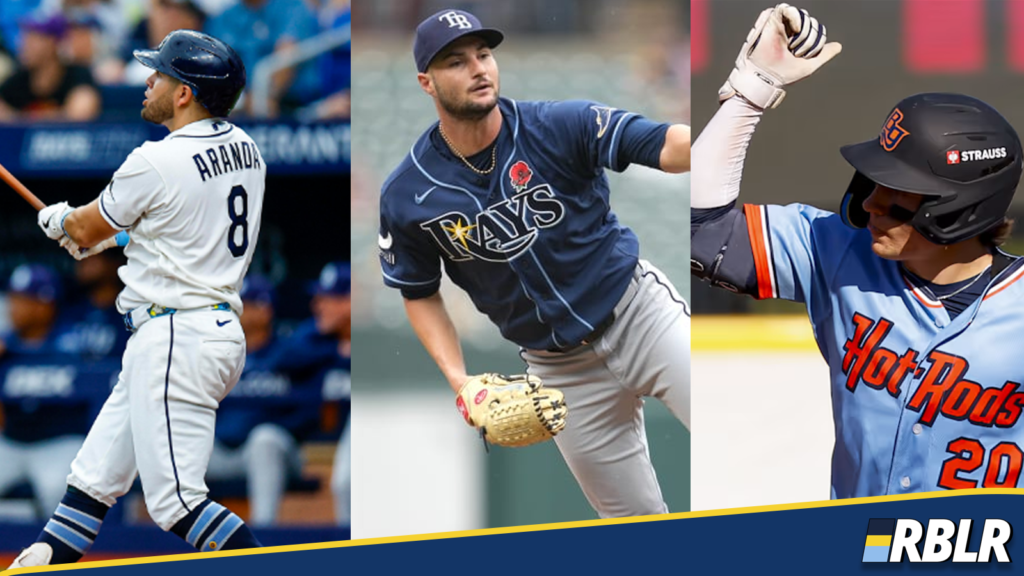
The Rays are giving fans plenty to watch: A red-hot stretch at the plate, a trade slowly paying dividends the right ways, & a teenage prospect suddenly appearing on national radar. The storylines are stacking up as the season hits its stride. Our writers dig into the numbers: pitch-mix adjustments, analytical shifts, and the development leaps no model saw coming, painting a clearer picture of where this team is headed.
Jacob Macauley (@raysfarmreport) : Rays Of The Month for May
The Tampa Bay Rays enjoyed a torrid May. After the conclusion of Sunday’s game against the Angels, the Rays finished the month 18-8, and plenty of strong performances are to thank for it. Jonathan Aranda, Yandy Díaz, and Junior Caminero all finished within the top 19 in wRC+ for the month, while Shane McClanahan and Nick Martinez both carried sub-3.00 FIPs and ranked within the top 23 among qualified pitchers.
Best Bat: Jonathan Aranda
As good as Yandy and Junior were, there isn’t much of an argument here. Aranda’s 179 wRC+ in May led all qualified Major Leaguers, and he also accumulated a team-leading 1.2 fWAR. By his standards, April was dismal. His 95 wRC+ was his worst mark in any month since August 2024.
It seemed as if Aranda got away from himself earlier in the season. His strengths will always be spraying line drives and occasionally driving the ball out of the yard. In May, his middle-of-the-field usage rate ticked up 16%, while his pull rate plummeted 14%. His line-drive rate also climbed by 6% — all welcome sights for the Rays’ first baseman moving forward.
Best Arm: Shane McClanahan
It feels criminal to snub Martinez of this honor, but this is another circumstance where someone else was simply a bit better. McClanahan endured a bumpy first few starts back, posting a 13% walk rate (12th percentile) alongside a 4.1 xFIP, which sat nearly a full run above his career norm.
Much of McClanahan’s early-season struggles stemmed from his first three starts, during which he posted sub-50% first-pitch strike rates and a below-average zone rate (45.9%). However, after his start in Chicago, both metrics improved dramatically (+12% first-pitch strike rate and +4.4% zone rate). Those improvements have translated into far more productive outings, as his K-BB% has climbed from 3.4% to 20.1%.
From a pitch-mix standpoint, the biggest adjustment has been doubling his curveball usage in May. The pitch has produced extremely encouraging results, including a 48.5% zone rate and a minuscule .195 wOBA allowed (80th percentile).
At some point, the Rays will likely need to scale back Shane’s workload, but his in-season development as a strike-thrower makes this rotation especially exciting heading into the stretch run.
Carter Brantley (@ctbrantley12): Revisiting the Randy Arozarena trade
Rays received: Brody Hopkins, Aidan Smith
Mariners Received: Randy Arozarena
Winner: Too early to tell
The Randy Arozarena deal has gotten off to a solid start for both teams. Arozarena himself is scorching in 2026, with a 153 wRC+ and a smarter approach on the base paths.
Last season, his first full year with the Mariners, Arozarena managed to put up a good-if-not-great season. He posted a 2.9 fWAR, with decent on-base ability and pop.
This year looking at his under-the-hood marks would suggest that some regression might be in order, as he’s not hitting the ball especially hard or being super patient. But regardless, for a team that’s been in contention mode over the past 3 seasons, Arozarena has been exactly what the Mariners could expect. A good hitter who is going to be a below-average left fielder.
As for the Rays side of this deal, Hopkins is doing a lot of the heavy lifting in terms of carrying the return. The good news is he’s been excellent and is one of the more popular pitching prospects in baseball.
Hopkins has a filthy cutter that he showcased last year in the Futures Game, and has a promising slider/sweeper to go with an upper 90s 4-seamer.
He has the upside of a future ace and could make this deal not only equal for both sides, but maybe even a win for the Rays.
Aidan Smith is still in the lower levels and struggling a bit offensively. The massive risk with his profile is a subpar hit tool, but he should have enough power to be somewhat dangerous at the plate. He’s got solid speed and could potentially stick in center; if he can capitalize on his athleticism and be good enough defensively, that’ll ease the burden of his bat falling short of expectations.
There’s still much to be determined about this deal, but overall both sides have to be happy with the early returns.
Cory Ketchum (u/FLBoy19) : A Sustainable Catching Prospect?
In mid-April I discussed Nathan Flewelling, a catching prospect who had generated only a .229 batting average and .336 slugging percentage in 2025 as an 18-year-old in A-ball. I stated that Flewelling would be a top 100 prospect by the end of the year and that his hot start signaled what could be the end of the Rays’ catcher drought. Well, for the first time since Justin O’Conner rode a properly aged season to becoming a legit prospect in 2015, the Rays have a catcher on Top 100 lists. The key difference is that Flewelling feels sustainable.
The MiLB landscape has changed drastically in those 12 years, with average age-to-level inflating due to league contraction and the removal of short-season leagues. Justin O’Conner put up a good year for a catcher; however, he was properly aged as a 22-year-old in High-A in 2014, with most of his value tied to an 80-grade arm and raw power that produced 12 HRs. He predictably flamed out in AA in 2015, showing up only on MLB Pipeline’s top 100 list at #61. MLB Pipeline is considered middling at best, with Baseball America, Baseball Prospectus, Fangraphs, and whoever Keith Law is writing for generally considered better for projecting future value. Projections are hardly foolproof. As someone who has done a lot of modeling for graduate work, I find they serve as a framework for possible results; but are not infallible. However, multiple calibration runs provide rough confidence for results, and multiple prospect evaluators provide those additional calibration runs.
Going back to O’Conner, his 2014 stats had holes: his OBP sat at .316, and even with a .278 batting average, his wOBA was .355, heavily inflated by younger competition in High-A (.365 wOBA in High-A vs. .314 in AA). This is why his inclusion occurred only on MLB Pipeline. Flewelling, meanwhile, was placed on three just-missed lists this preseason and now resides at #88 on MLB Pipeline and #83 on Baseball America. He has not slowed down either, already eclipsing 10 HRs with a .282/.389/.921 slash line, good for a 136 wRC+ and .408 wOBA as a 19-year-old in High-A. Fangraphs and Keith Law have yet to update their lists; upon their update, Nathan will surely be within the top 100 on both. At this point, the question is where the 19 year-old Canadian ends up by the end of the year. If his production remains stable in high A and his eventual leap to AA this season, the Rays will have a top-30 prospect in baseball at catcher.
Edit post writing: Nathan Flewelling has been named Keith Law’s #47 prospect. At this point Nathan Flewelling could be a top 20 prospect by the end of the year.
The RBLR Rays Roundtable is a weekly collection of analysis, insight, and perspectives from a cast of writers assembled because of their unique backgrounds and experience. Check this space weekly for new updates and features covering the Tampa Bay Rays, the Rays’ minor league prospects, and more!