Four Trades Later, the Rays Mean Business
In the weeks leading up to the trade deadline, President of Baseball Operations Erik Neander echoed that they’d be more inclined to be aggressive if they felt like they were in a position to win the club’s fifth division crown in franchise history.
Aggressive they were, as the Rays completed four transactions in roughly 36 hours of time.
Tampa Bay improved all three groups of their roster significantly and has now seen it’s Fangraphs World Series odds jump to 8.2% (+2.2% improvement), which would be a season-high.
What are the Rays getting? Is it going to be enough to hold onto their 3.5 division lead? And how does this help them in an inevitable postseason run?
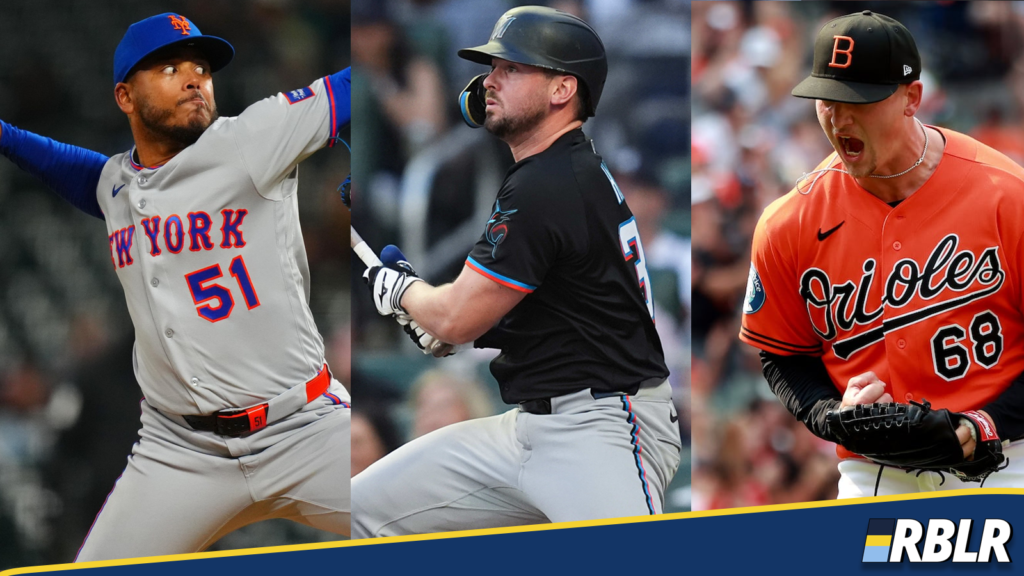
Rays acquire RHP Freddy Peralta from the Mets in exchange for RHP Gary Gill Hill (45 FV), OF Aidan Smith (40+ FV), and INF Emilien Pitre (40 FV) –
After the Tarik Skubal trade was announced, it felt like a race among contenders to see who would jump into the rental starting-pitcher market first. Erik Neander wasted no time and acquired Peralta, jumping the rental starting-pitcher market and acquiring the best option available.
It’s well documented that Peralta has had a difficult season in terms of his results. Freddy holds the fourth-highest ERA among qualified starters and the eighth-highest FIP; the track record is strong (career 3.7 ERA & 3.7 FIP), but is there reason to suggest a bounce-back?
Freddy has dealt with a few specific issues this season, in particular vs both sides of the plate. Against right-handers, Peralta has seen his whiff% vs them crater to 24.6% (31.7% career), and that has been his story all season vs right-handed hitters. His breaking balls have lagged from a results standpoint (.400 wOBA allowed off slider, .359 off sweeper), and the ineffectiveness of those pitches has played a big role in his decline vs. right-handed batters this season.
As for vs lefties, Peralta is getting plenty of misses against them this season, as his whiff% is at 28.1% (70th percentile), but his .209 ISO (20th percentile) allowed this season vs lefties is something on the surface to be concerned about. Despite the high ISO allowed, Freddy is only allowing a 38% hard hit% (65th percentile) and 6.2% barrel% (70th percentile) vs lefties this season, so this is largely just a variance issue that will correct itself.
Overall, I am expecting the Rays to have Peralta ramp up his changeup usage vs right handed batters, a pitch that is only being hit hard 21.4% of the time and a pitch he shows plus command for (36.4% changeup zone rate).
The price to get Peralta was certainly not as high as I expected it to be, as the three names the Rays gave up are all projected to be depth/role players at the major league level. The one I am most upset to see go is Aidan Smith. Smith was acquired at the 2024 trade deadline from Seattle for Randy Arozarena, and ever since his breakout 2024 season, when he posted a 143 wRC+ hasn’t been able to find his footing in the Rays system. Aidan has battled a few injuries that have slowed progression, and his hit tool concerns have really popped up in A+ as he has posted back-to-back north of 30% K% seasons in Bowling Green. Even with the bat not progressing as intended, the power is pretty legit, and he is easily a plus athlete and defender in center field, leading him to have the highest ceiling of the group.
The 2026 Rays get much better with this deal regardless of a rebound from Freddy, as he provides much-needed insurance to a rotation that continues to approach uncharted territories in the innings department. The upside, durability, and postseason experience provide Peralta with a significant chance to make a big impact in the postseason and give the Rays more options in how they deploy their pitching staff in October.
Rays acquire C Liam Hicks from the Marlins in exchange for INF Brayden Taylor (50 FV), INF Adrian Santana (40 FV), and RHP Jacob Kisting (40 FV) –
Once the Rays missed out on Luis Arraez, a lot of fans wondered where the Rays would go next to add a much-needed bat in a lineup that has largely been carried by three hitters. Erik Neander called up old friend Peter Bendix and swung a substantial deal to acquire Liam Hicks from the Miami Marlins. Tampa Bay had attempted to acquire Hicks in the 2025 Rule 5 draft, but he was selected by the Marlins, and the teams had a trade that fell through.
Hicks was enjoying a breakout sophomore season in South Beach as his 119 wRC+ ranks 12th among qualified backstops this season. Liam provides some versatility as he has played a good bit of 1B, but the Rays see him as their primary catcher moving forward and for good reason. Liam has made strides to improve against the running game, as his pop times have improved to a plus mark this season (1.93 seconds) and his arm has graded out as average the last two seasons. His framing is passable, certainly not great, but the Rays have rostered worse (Danny Jansen), and with the introduction of ABS this season, it certainly protects that part of his game more than it would have in years past.
The bat is certainly the calling card with Hicks; its elite bat-to-ball skills (97% IZ Contact%, 100th percentile) paired with a more passive approach, which should lead to improved at-bats within the lineup and some fringey pop that is playing up this season thanks to his ability to get into the air to his pull side.
As expected, the price for Hicks was going to be steep due to the Marlins not being inclined to move him, paired with the fact he isn’t a free agent until 2031, but I think the Rays did very well in this deal. The main prize going back to Miami is former first-round pick Brayden Taylor. Taylor has had a bumpy road throughout the minor leagues, rising quickly into a top 100 prospect and then having a year in 2025 that had most fans scratching their heads, wondering what happened. Brayden’s 2025 had uncharacteristic swing-and-miss issues pop up in his game as he struck out 27.7% and posted a 77 wRC+ in his first full season in Montgomery. This season he has fully bounced back, cementing himself as a top 100 prospect as he has slashed .284/.384/.513, good for a 136 wRC+. Taylor doesn’t possess many elite traits, but maximizes his below-average raw power, allowing it to project to average. The inability to play a premium position and a passive approach that I think will be exploited as he continues to move up the ladder is why I am not losing sleep over this price for Hicks.
The 2026 and 2027 Rays get significantly better with this transaction, and Hicks should be a perfect bridge bat for this Rays lineup. Hicks could also be the long-awaited answer at the catcher position for Tampa Bay, which is another reason to get excited about this deal.
Rays acquire RHP Tyler Wells from the Orioles for RHP Michael Forret (50 FV) –
After the Hicks deal, I was assuming that the Rays were done adding to their major league roster, but they swung one last Major League deal, and that was acquiring RHP Tyler Wells from the Baltimore Orioles. I am generally not the biggest fan of acquiring relief pitching at the deadline due to the prices and variance of the position, but this Rays bullpen that ranks 22nd in FIP needed a boost.
In addition to Liam Hicks, Tyler Wells is enjoying a breakout season, posting career-best strikeout numbers and a career-low ERA. At an imposing 6’8 270, Wells comes at hitters from a high slot (52° arm angle) and five unique shapes. Tyler primarily gets it done with his two fastballs (FC/FF) and his best out pitch, which is his changeup.
In his first full season back after suffering an injury in 2024, Tyler has ascended from someone who was a swing arm/back end starter to someone the Orioles depended on to get outs for them in the 7th/8th inning. The evolution of his cutter has been the big story this season as he’s doubled the use of that pitch, and he’s gotten strong results as it has generated a 33.6% whiff% (93rd percentile) and a 32.3% hard hit% (90th percentile).
The message all season from the Rays to their pitchers has been pretty simple, and that is changeups, and they’ve identified another good one. Tyler’s changeup stays on plane with his cutter, allowing those two pitches to tunnel together and play up above their shape. Wells has surrendered a .234 wOBA and generated a 34% whiff% (95th percentile) on the offering, and it’s playing a huge role in his success. Wells comes with elite pitch execution, a ton of strikes, and a unique look out of the Rays bullpen.
As for the return, I was admittedly very surprised the cost was this high. Forret was my personal favorite pitching prospect in the Rays org, and I thought he had an outside chance to contribute as early as this season. Forret comes with a ton of strikes and plus pitch execution. The shapes are a little lackluster as he doesn’t throw very hard or come with an outlier secondary pitch, but he is easily at the worst a backend starter moving forward. The Rays likely see that he doesn’t have an outlier shape, alongside the fact that he is Rule 5 eligible this winter, and do not feel that he is worth protecting, but this was a price I wasn’t expecting to see.
Wells comes with another season of club control, so this likely positively impacts the team this year and next, but that price is incredibly steep. I am a huge fan of Wells, though, so I think it will be worth it at the end of the day. A Rays bullpen including Wells, Baker, Kelly, Rodriguez, Cleavinger, Booser and Matz is extremely exciting and something I am certainly looking forward to.
Rays acquire OF Jack Suwinski and international funds in exchange for C Hunter Feduccia and RHP Jacob Kmatz (45 FV) –
The Rays beat the buzzer by acquiring Suwinski, who has been a long-rumored target for Tampa Bay. The Rays required some depth in their LHH outfield group due to injuries to Jake Fraley and Jacob Melton, and Jack provides that.
The Dodgers claimed Suwinski on waivers in February of this year and outrighted him to AAA, leaving him not needing a 40-man roster spot, and he has flashed big improvement. The knock on Jack has always been the lack of contact that he comes with, but this season in AAA he has raised his Z-Contact% to 83.9% while not sacrificing any of the high-end batted ball impact (13.2 barrel%) he comes with. Suwinski has a strong approach (42.2 Z-O Swing%) and great feel to get the ball in the air (66.1% air rate), maximizing his slug potential.
Jack is a passable defender and profiles best for left field, but has major league experience at all three spots in the outfield, making him a premium depth acquisition and possibly something to dream on long term if the bat shows up in the Major Leagues.
As for the return in the deal, it has always felt like Hunter Feduccia was bound to be off the team one way or another. The constant mental blunders and lack of production made it very difficult to rationalize rostering him into a stretch run.
Jacob Kmatz, a former 2024 5th-round pick out of Oregon State, is certainly the prize of the package here for the Dodgers as he projects to be an impactful reliever at some point in the near future. Kmatz pairs a plus fastball with two plus breaking balls alongside plus command and has shot up in his 2nd full season in the Rays organization. In his transition into a full-time bullpen role, Jacob has improved his K% by nearly 20% and has slashed his BB% by 2.5%. Kmatz is at least two seasons away from being big league ready, but this is a legitimate price to pay to acquire Suwinski.
Overall, this is yet another move by the Rays that strengthens them and makes the 2026 (and possibly beyond) Rays much better. The added depth and long-term upside of Suwinski to me is certainly worth it, and I am fascinated to track his development in the Rays system.
—
In total, the Rays made four trades, dealing two 50 FV (according to FanGraphs) players, two 45’s, one 40+, three 40’s, and even one major leaguer. They remained atop FanGraphs Farm System rankings, but their total value dropped $120M ($710M -> $590M) signaling how committed they are to really going for it this season. Tampa Bay avoided trading their most impactful prospects and dealt from within their surplus of depth which to me at least makes this a very productive and successful 2026 trading deadline.