RBLR Rays Roundtable 2025 #3 – Players Worth the Price of Admission
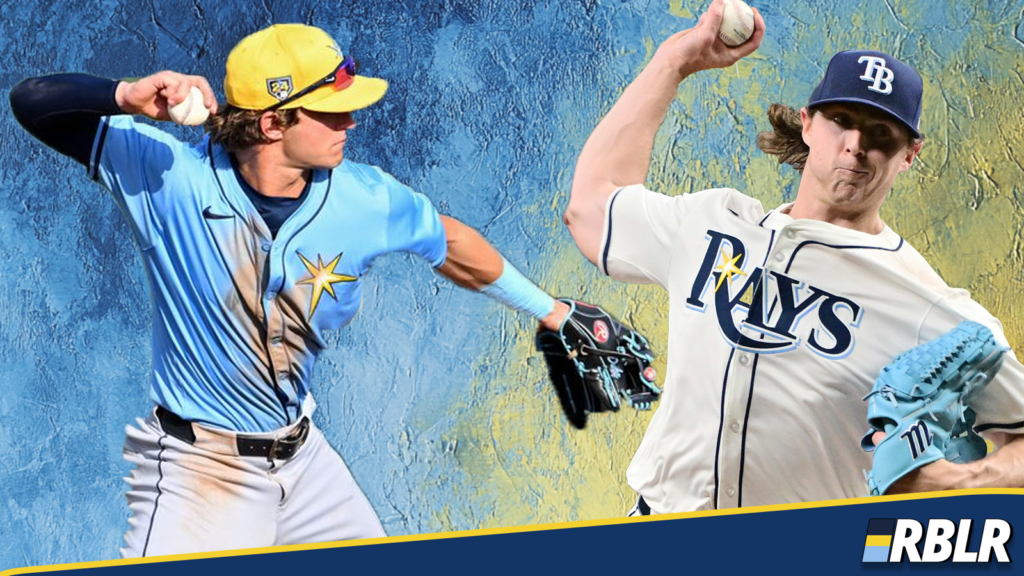
As the 2025 season approaches, key storylines are emerging – whether it’s Ryan Pepiot’s breakout potential, the impact of Steinbrenner Field’s pricing on fans, the significance of the 2021 draft class, or the latest prospect rankings from Fangraphs.
Let the roundtable get you ready for the week!
Jacob Macauley (@raysfarmreport) : Will Pepiot Breakout?
My dark-horse Cy Young candidate for this upcoming season is Ryan Pepiot. Pepiot, who was part of the return for Tyler Glasnow, and had quite the first season with the Rays – posting a 3.60 ERA and 17.4 K-BB% across 130 IP.
Pepiot had incredible moments last season for the Rays, including a 12 K performance that included an immaculate inning versus the Red Sox on September 18th. The star pitch for Pepiot was certainly his 4-Seam Fastball. Pepiot held opponents to just a .181 average vs his fastball, which was fourth among starters last season. Stuff metrics also adored Ryan’s fastball last season; it generated 3.1 inches of ride compared to the average fastball, and it was tied for 2nd (with teammate Taj Bradley) among starters in fastball Stuff+.
From Opening Day to July 14th, Pepiot essentially had a three-pitch mix: 51.4% fastball, 21.9% changeup, and 21.5% slider. However, coming off his one-month absence on the IL due to a knee infection, Pepiot significantly increased his cutter usage to 12.7% making it a 10.5% increase in usage after his IL stint. Ryan’s cutter is a quality offering, grading out as a 103 stuff+ offering from August 16th to the end of the season, and should’ve led to better results than it did given its .267 xwOBA. If Pepiot can continue to get comfortable using the cutter to pair alongside his quality mix, I think the Rays have a real Cy Young contender on their hands for this upcoming season.
Sandy (@SandyAndTheRays) : The Steinbrenner Surcharge
Like me, you may have been anxiously awaiting last Wednesday’s 10 am ET regular season single game presale. I was mostly interested in the prices of the games I would be attending in late May, despite the fact that I don’t live in Tampa.
Given the price of season ticket plans and the increased demand for a ballpark with a lower capacity, fans were already anticipating that single game tickets would cost a pretty penny. In my case, when I looked at a weekend series and a Monday game, the cheapest ticket for the Saturday game was $96, while the cheapest ticket for the Monday game was $61. Now, when it comes to going to baseball games, I’m typically quite frugal. Not nosebleed seats-level frugal, but reasonably frugal for a working professional who would be going to every game in a Rays-Yankees series at Yankee Stadium. If you can give me the uppermost level view along the third baseline for less than $40 ($50 if we’re really pushing it), I’ll take it. So unless it’s a marquee match-up like the Yankees vs. Red Sox or a game with a high demand giveaway item, I’m not really used to seeing something like $61 for the cheapest ticket available.
Although baseball wasn’t a large part of my childhood, I frequently hear from longtime baseball fans about how affordability helped them and their families become fans and go to a lot of games. As an adult, I’ve even paid as little as $7 to attend a Mets game. Yes, we can all understand why things are the way they are this season because it’s not like the Rays asked for a natural disaster to destroy their ballpark, and the smaller Steinbrenner Field is merely their temporary home. Even still, that doesn’t make it any less disappointing for devoted fans who might be priced out and unable to attend as many games as they typically would.
I will be a bit lucky since I may be able to attend some of the games with a family of three as an add-on (they are splitting a season ticket plan with a friend, and their plan is for four tickets). If that weren’t the case, I would have to closely monitor my spending and savings over a few months. So I feel for Rays fans, especially those in the Tampa Bay area, who may be watching the majority of this season’s games on television despite their passion for the team.
Dustin Teuton (u/FLBoy19) : Fruit From The 2021 Draft Tree
The 2021 Draft may be the most crucial in recent memory for the Rays. After taking a big swing on Nick Bitsko in 2020 (only to see him sidelined by shoulder issues) the Rays needed a rebound. Ian Seymour is the lone bright spot from that class, but 2021 offered a fresh chance to take risks.
Tampa Bay did just that, selecting Carson Williams in the first round. A surefire shortstop as he matured, Williams joined an organization that already had Wander Franco, whose long-term position was still uncertain. The pick has since proven impactful, giving the Rays a potential long-term answer at shortstop. They doubled down in the competitive balance round by drafting prep second baseman Cooper Kinney, another aggressive pick. With a $7.96 million bonus pool, the Rays typically allocate funds to high-upside prep players later in the draft. Instead, they committed 56.5% of their pool to Williams and Kinney, neither of whom signed below slot. Williams had swing-and-miss concerns, while Kinney lacked a clear defensive home.
Williams has since blossomed into an elite prospect with a 30-30 ceiling and stellar defense. Kinney, while less heralded, has made strides, improving to an average defender at second. After returning from a labrum tear in 2023 (110 wRC+), he truly broke out in 2024. At 21, he was the second-best hitter in High-A’s South Atlantic League, trailing only 22-year-old top-100 prospect Brayden Taylor. Kinney slashed .289/.352/.846 with 10 homers, a .205 ISO, a .381 wOBA, and a 137 wRC+. His line-drive-heavy (32.7% LD%) approach and all-fields contact highlight his advanced bat.
Barring another setback with his surgically repaired left labrum, Kinney’s progress in Double-A will be key as he enters his 40-man decision year. If he keeps hitting, the Rays may have an internal successor to Brandon Lowe at second or a valuable trade chip. With Mason Montgomery primed for a bullpen role and Williams emerging as a star, Kinney’s development could solidify the 2021 draft as one of the best in recent Rays history.
Jake Shutters (@JakeShutters) : Did Fangraphs Get “56” Prospects Right?
In the grand scheme of things, prospect rankings mean little to how a player translates to the majors. Top ranked prospects become busts, and players come out of nowhere to be future stars. However, they allow the average fan a glimpse into how the industry feels about a team’s minor league system. Fangraphs recently released their updated top 56 prospect list, and these things stood out to me, for better or worse:
- This Rays system is deep. In this update, the Rays had 1 player with 60 FV (Carson Williams), 5 players with 50 FV, and 4 players with 45+ FV, all of which are under 23 years old. For reference, the Yankees had 4 combined. The player development machine the Rays have become has almost never been on display as much as it is now.
- The largest disservice Fangraphs did, in my opinion, was to Aidan Smith. Smith, in my opinion, is an worst a top 8 prospect in the organization, and he was placed at 20. Smith’s impressive minor league resume only improved one he was brought in from Seattle, going from a 135 wRC+ to a 155 wRC+ in A ball as a 20 year old. Along with his speed and defensive in center field, expect Smith to be a riser in 2025.
- Finally, the industry loved what the Rays did at the 2024 trade deadline. Along with the previously mentioned Smith, names like Brody Hopkins (4), Jackson Baumeister (12), Ty Johnson (18), Dylan Lesko (23), and Gregory Barrios (25) are all present in the top 25 of the list. What could be seen as the end of an era in 2024 could lead to the start of a new one in the future.