Life After Lowe: The Rays’ Battle At 2B
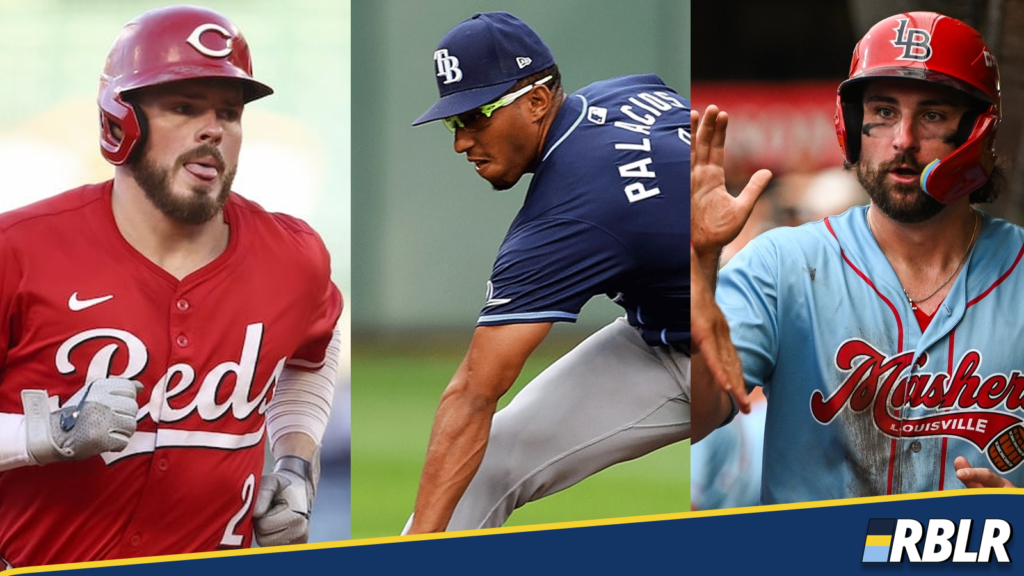
The Rays enter a period of unfamiliarity at second base, a position previously anchored by Brandon Lowe for the last seven seasons before he was recently traded to Pittsburgh. So the question becomes: where do the Rays turn? Richie Palacios provides an internal option, while recent trade acquisitions Ryan Vilade and Gavin Lux should also factor into the mix.
Richie Palacios
Palacios was enjoying a strong debut season with the organization, posting a 101 wRC+ and ranking among the league’s best in BsR, but a knee injury suffered against Miami halted what appeared to be a breakout. He entered 2025 with high expectations to help stabilize an outfield filled with uncertainty, but once again, nagging injuries shortened his season to just 17 games and 48 plate appearances.
In 2024, Palacios ranked in the 85th percentile in OBP and landed in the same percentile in BsR, displaying legitimate plus offensive value. His plate discipline ranked near the top of the league as well, chasing pitches at an 85th-percentile rate while avoiding passivity by swinging in the zone at a well-above-average clip. Although it was a small sample size (262 innings), Palacios logged four DRS during his time at second base.
Inconsistency staying on the field makes it difficult to rely on Palacios as the everyday answer at second, but there is no denying that his OBP skill set makes him an easy plug-and-play option in this lineup. If he enters the season healthy and his defense and baserunning hold up post-injury, Palacios should have a legitimate shot to open the year as the Rays’ primary second baseman.
Ryan Vilade
Vilade is a well-traveled player at this point, with Tampa Bay marking his sixth organization since 2022. He was acquired early in the offseason from Cincinnati in exchange for cash and is poised to compete for a major league opportunity heading into spring training. Vilade is out of options, meaning he will either have to make the roster or be placed on waivers.
There is no denying Vilade’s strong minor league track record, as he has posted a 123 wRC+ since 2024. His underlying metrics are impressive as well, flashing double-plus bat speed (83rd MLB percentile), a 113.4 mph max exit velocity (~65th MLB percentile), and an 89.3% zone-contact rate (~80th MLB percentile). Vilade also provides defensive versatility, having played every position other than catcher during his professional career.
An immediate everyday role would be risky to hand Vilade, as he has produced just a 9 wRC+ and a -0.6 fWAR across 71 career major league plate appearances. Still, his minor league production and underlying tools earn him a legitimate opportunity to compete for the second base job.
Gavin Lux
Lux is the newest Ray and appears to be the early leader, with President of Baseball Operations Erik Neander stating, “He will primarily play second base for us and some outfield.” Lux has dealt with multiple injuries throughout his career, most notably a season-ending ACL tear in 2023 that halted momentum following a breakout 2022 campaign.
Since then, he has struggled to live up to his prospect pedigree, producing roughly league-average offense while grading well below average defensively.
Given that baseline performance, why might the Rays still have optimism about Lux? For starters, he thrives against right-handed pitching. Last season, Lux posted a 111 wRC+ versus right-handers and reached base at a .361 clip (~80th percentile). He also made notable improvements in zone contact rate and chase percentage, setting career highs in both areas. Lux adds flexibility to an outfield group that has its own set of questions, and for most of his career, he was regarded as a solid defender at second base (1 OAA, 3 FRV). However, the last two seasons have been rough, with those marks falling to -8 OAA and -3 FRV.
Lux projects as a quality platoon option and appears to be the frontrunner for the bulk of the second base workload. Still, his struggles against left-handed pitching (33 wRC+ in 2024) and recent defensive decline should leave the door open for other candidates to push for a larger role.
Of the multiple position battles discussed so far this offseason, this group carries the most uncertainty and intrigue heading into spring training. As things stand, Lux appears to be the most likely option to take over the role, largely due to his major league track record and overall production to this point. Even so, this competition remains wide open, and it will be one of the more fascinating storylines to monitor as the season approaches.