Nitty Gritty Needs: Ancillary Priorities and Day 3 Looks
While the Bucs backup Tackle situation seems to have been solved by replacing Charlie “What The” Heck with Justin Skule, who was a serviceable swing Tackle for Minnesota last season and for Tampa Bay the year before, and Ben Chukwuma, a UDFA from last season, may actually be the top Backup along the entire line next season after a very impressive few starts when Tristan Wirfs went down in week 14.
But the interior of the offensive line was an absolute mess last season. LG Cody Mauch tore his ACL in week 2, RG Ben Bredeson missed six games, and having both backups on the field at the same time was an absolute disaster. Combine that with regression from C Graham Barton, who started the season at LT for an injured Tristan Wirfs, and it was pretty ugly all around. They did not play a game all season with all five starters, and their interior offensive line backups were much worse than expected.
Additionally, while the starting Tackles are both locked up through 2029 (the only Bucs with contracts ranging that far, assuming Zyon McCollum, Ben Bredeson, and Chris Godwin do not get extended through their Void years), Barton will presumably hit free agency that season, assuming his fifth year option is picked up for 2028, Bredeson will hit free agency in 2028, and Mauch will hit free agency after this season. While they have viable starters at all five positions, the IOL could be “Mission Critical” next offseason when you factor in injuries, development, and contract situations.
That being said, none of the interior offensive line positions are what would be considered “premium positions”. At maximum, two to three will be drafted in the first round, but most decent guards are veteran tackles who slide inside when the OT job doesn’t work out.
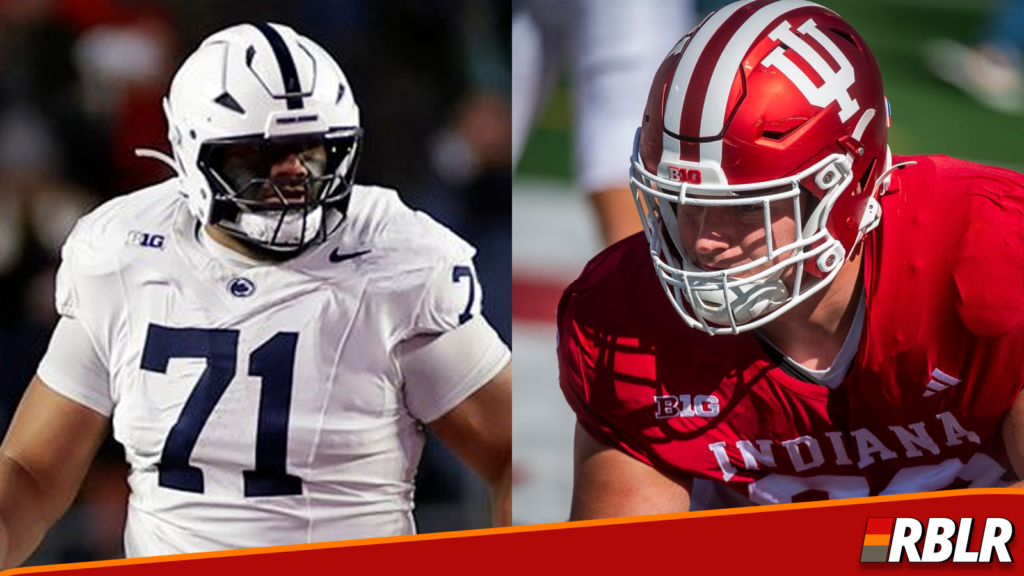
OG Olaivavega Ioane (PSU) 1st round
Another projected Buc (at least according to National Media), Ioane is an ideal Guard prospect who will quite obviously be very successful at the next level. Yes the Bucs O-line struggled mightily last season, especially at Guard. But Guard is not that big of a need. Mauch and Barton are young and need further development, sure, but they and Bredeson are good enough that a Guard in round 1 is bad value. Guards and centers in round one are almost always bad value anyway. He’ll be great elsewhere, but Tampa ought not be making this pick.
OG Keylan Rutledge (GTU) 3rd Round
Rutledge, the former Basketball player and shot-putter, is a freak athlete, much like Ioane, but is much more raw in his technique. His move skills and agility combination make him a dangerous puller, and he would excel in the Bucs gap-heavy scheme. He would be a better value pick in the third round to develop behind Mauch and Bredeson, as they’re both on multi-year contracts, and could take over when one expires. His hands and feet are both choppy, but easily fixable, especially by one of the best offensive line coaches in Kevin Carberry.
OG Anez Cooper (UM) Day 3
Cooper is another instant scheme fit. He’s a huge human being that struggles to move laterally in space, but is absolutely devastating downhill. His large frame and wingspan along with his extensive resume as a 4-year Power 5 starting guard make him an intriguing pick. He’s got some technique issues similar to Rutledge, and his physical limitations due to his size will cause him to fall much further
OG Billy Schrauth (ND) Day 3
Schrauth’s career at Notre Dame was unfortunately shortened due to lower body injuries, which kept him out of 11 games between the last two years. His ceiling could be a lot higher than what he showed on tape, but it’s hard to make that judgement on such limited tape. He’s a great pass protector but seems limited in creating push, which limits his fit as potential Buc, but Jason Licht has been complementary of the Notre Dame football program in the past and has drafted successfully from their offensive lineman room before, most recently with Robert Hainsey.
C Jake Slaughter (UF) 3rd round
The floor here is fairly high. Slaughter gave up one sack and one QB hit for the whole of 2025, and he did it against the hardest schedule in all of college football last season. He’s a great athlete, with good speed and agility, but he will absolutely need to put on mass. He’ll also need to figure out the run game, but the Florida run scheme wasn’t all that complex, so it could be that he just needs to be coached up a little. He won’t be a first year starter, but with a little work with the right staff and group around him, he could be a long term starter.
C Pat Coogan (IU) Day 3
Pat Coogan. Where to even begin? The first offensive lineman to win Rose Bowl MVP since WWII, Pat Coogan first made a name for himself on a fantastic squad with Joe Alt, where they paved the way for Audric Estime’s 18 touchdowns, a program record. Coogan transferred to Indiana, where he would win the national title. He gave up 0 sacks or QB hits last season across 480 snaps. But there are legitimate questions about how his game will translate to the NFL. He’s not fast, and his arms are short, both of which will initially limit his abilities, but he’s got the brains, and he’s gotten better with every year across two power five programs where he started 41 out of the 45 games he played in college.
Though the Bucs added A’Shawn Robinson and Rakeem Nuñez-Roches to shore up the front seven after losing Logan Hall and Greg Gaines, they could still use another backup, especially when you are relying on a player like Calijah Kancey, who has yet to play a full season in his three years in the league. Unfortunately this is a fairly weak class of defensive tackles in particular, but they likely wouldn’t be using a premium pick at the position anyway.
DL Caleb Banks (UF) Late 2nd Round
Caleb Banks is gonna make some defensive coordinator very happy on Day 2. He’s 6’6” and 330lbs with an 85 inch wingspan, and he gets a pretty great jump on the snap. He unfortunately broke his foot at the combine, which is a major concern, but he’s got a quarter ton of raw tools to perfect at the next level. He lined up everywhere from Nose Tackle to Wide Nine, and he’s got a great motor for someone his size. But he needs development of his pass rush moves and skillset, and he needs to quit arm tackling, something you can get away with in the FBS when your arms are that huge.
NT Christen Miller (UGA) 3rd round
Who wouldn’t want a Georgia Bulldog Nose Tackle? They’ve turned themselves into the Defensive line Factory, with big time stars like Jordan Davis and Jalen Carter making splash plays for the Eagles. Miller carries that lineage with pride. He’ll successfully anchor a run defense in the NFL, and while he probably won’t put up any sort of gaudy numbers, he’ll eat double teams all day every day. If he could rush the passer, he’d easily go in the first round, but who’s to say he can’t develop that part of his game at the next level? All the tools are there.
NT Darrell Jackson Jr. (FSU) 4th round
I’m not sure Jackson intends to rush the passer. Another double team eater, he’ll be a fine rotational piece at nose tackle in his first year. The real question is if/when he will develop a counter to his bull rush, because one move alone could significantly raise his floor. He could be an immediate improvement over Greg Gaines at bare minimum, with a higher ceiling. His massive size unfortunately won’t lend him to much more than his run-stopping Nose Tackle play style.
While Wide Receiver is their strongest position in terms of talent on the roster, with the departure of Mike Evans leaves them without a true X receiver. While they did sign David Sills V, presumably to be the WR5, he’s the tallest receiver on the roster at 6 ‘3″. Besides, why not throw another dart at the board for the position that Jason Licht has consistently picked best.
TE Kenyon Sadiq (ORE) 1st round
Ok fine, he’s not a wide receiver. But there’s a fair chance he’s the best pass catcher on the board when the Bucs pick at 15, and there’s been significant buzz about him being the Bucs selection. Cade Otton is a fairly above average starter, with an unfortunate number of massive gaffes that far overshadow his best plays. Behind him, the Bucs have Payne Durham, a big body who’s an ok blocker and rarely a pass catcher, Ko Kieft, who is mostly a special teamer and occasional fullback, and Devin Culp who was a project prospect as a late round pick in 2023, who has six catches for 74 yards and touchdown, with only one of those catches (for six yards and a score) came last season even though he saw game action in 13 games.
Sadiq projects as a rare talent at the position, with the frame of a Sam LaPorta-type, and elite speed, strength, and agility. People that are 6’3” and 241lbs do not deserve 43.5 inch vertical jumps or 4.39s (!!!) 40-yard dashes. He’s an athletic freak of nature. But this feels like OJ Howard all over again. There are legitimate concerns over his drops, which occasionally happen in the wide open field with no one around, on throws that hit him right where they need to be. His blocking technique is just ok (not that it needs to be great), and they just signed a perfectly fine tight end to an extension. With as many needs as they have, it would, again, be foolish to draft a tight end at the value of a middle first round pick.
WR Denzel Boston (WAS) Late 1st round
So how do you replace Mike Evans? You don’t. But you could start by looking for similarly sized humans. Standing at 6’4”, he certainly has the height requirement. However, he isn’t very fast. His 4.60s 40-yard dash is in the 18th percentile for WRs, but he does have a well-developed route tree, in a pro-style offense, at a program Jason Licht seems to adore (having drafted Austin Sefarian-Jenkins, Vita Vea, Joe Tryon-Shoyinka, and Jalen McMillan from the University of Washington). And he’s a willing blocker. He certainly checks most of the boxes. But the Bucs would essentially spend a first round pick on a jump ball threat in the red zone, who’s touches would be limited by Chris Godwin, Emeka Egbuka, Jalen McMillan, Tez Johnson, and both Bucky Irving and Kenneth (who was fourth among running backs in receptions last season) as they’ll likely lean heavily on the screen game. He could certainly develop past that point, but the Bucs have allocated significant resources to the position including a first round pick last season when they had much more pressing needs. While that seems to have paid off, making the same decision two years in a row would be… interesting.
WR Chris Brazzell Jr. (TEN) 2nd round
Brazell is a curious prospect, and in any other decade, his 4.37 speed and 6’4” frame, and an 80-inch wingspan would make him a freak athlete. He’s got the rare separation speed that big bust receivers in recent memory have not (Laquon Treadwell, N’Keal Harry). His route tree is relatively limited, having come up in the Josh Heupel offense, but he showed improvement in his last season there. This is an even larger knock because he was never a “yards after the catch” receiver, relying more on his speed than ability in space to get the ball downfield. Raw but tool-y, the worst case scenario for the league would be for him to go to an offensive minded head coach on a contender, where he could develop and not necessarily need to produce as a rookie. There have been unnamed GMs in the media claiming ‘maturity issues’, but if he can expand the route tree, he could be a real dangerous X receiver.
WR Ted Hurst (GST) 3rd round
While there isn’t a ton of tape on Hurst, having played two seasons at Division II Valdosta state and two seasons at Georgia State in the Sun Belt, Hurst was a great tester. His height, broad jump and 40-yard dash all placed above the 90th percentile (6’3”, 11’3”, 4.42s). Certainly more of a Jack of All Trades receiver, rather than a Master of One, Hurst is at least proficient in the various categories. Above average speed, agility, route running, run after the catch, and ball tracking. He struggles with contested catches and press coverage, as his lighter frame (206lbs), lacks the functional strength to get off the line against handsy corners. You’d expect an NFL program to beef him up and give him as many live reps as possible in the offseason, and there are significant concerns about how he’ll look against NFL corners, especially given his not quite dominance against Sun Belt corners.
WR Ja’Kobi Lane (USC) Day 3
Out of these receivers, Lane might be the best value. A contested catch merchant, His sophomore season saw 43 catches for only 525 yards, but 12 touchdowns, good for fifth in the nation that season. His junior season didn’t exactly build on that success, with only four touchdowns despite only missing one game, his 6’4”, 80 6/8 inch wingspan, and 40 inch vertical is enticing to say the least. His 4.47 speed isn’t game breaking, but adequate. His struggles to separate, and produce after the catch are concerning, but for a guy who hauled in 49% of his contested catches (national average of 46%), and had 33% of his career targets be contested (99th percentile), he certainly looks to hang his hat on that skill. But he still had way too many drops, with four in each of his last two seasons. He has plenty of upside if he can develop a more complex route tree than Lincoln Riley’s Air Raid offense demanded, and add weight (200lbs won’t cut it), he could absolutely challenge for WR4 playing time by year 3.
Obviously, none of these positions have giant gaping holes on the roster, but they’re all one serious injury away from derailing the season, as all three of these position groups featured major, season defining injuries, including Mike Evans, who has now departed, Cody Mauch, who should be back to 100% by the time camp rolls around, and Calijah Kancey, the best pass rusher on the team who has played fewer than 30 games in his three seasons.