RBLR Rays Roundtable #12 – Grades, Grit, Trade Trees, and the Need for Mead
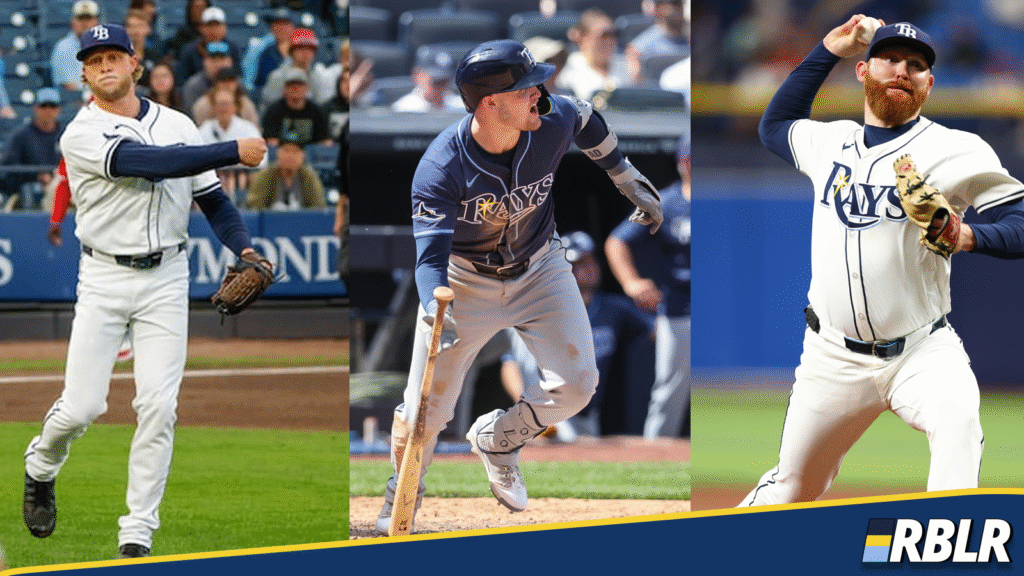
This week, our writers graded the team’s performance so far, recapped Saturday’s gritty win in New York, revisited the Archer trade and it’s bountiful return, and looked at what Mead is doing under the hood and why he should get some more playing time.
Jake Shutters (@JakeShutters) : Grading the Rays
The team is currently 15-18 with a 21.5% chance of making the playoffs. Here are my first month grades for the Rays’ efforts on the offensive and defensive sides of the ball this season.
Batting: The Rays rank 13th in the league with exactly a 100 wRC+, 21st in walk rate (8.3%), and 18th in strikeout rate (22.5%). They rank 21st in the league with 27 home runs, and 22nd in runs scored with 121. A graphic appeared on the broadcast yesterday underlining the main issue, an alarming difference between production vs right-handed and left-handed pitching. The Rays have massively struggled vs left-handed arms (65 wRC+, 26th in baseball), explaining their recent performance vs Max Fried and Ryan Yarbrough this weekend. Players will return and start to heat up, but for now, I can only evaluate what I’ve watched. C
Pitching: Different story. The Rays have borderline excelled at run prevention this season, as they have the best DRS in baseball at 23 in addition to being 8th in ERA (3.57), 4th in BB/9 (2.85), and 2nd in LOB% (78.9%). The issue? The home run ball. Giving up 1.31 HR/9 is the 6th most in baseball, and a large disparity between homers hit by the Rays (19th best HR/FB ratio at 9.7%) and hit against the Rays (5th worst HR/FB ratio at 13.2%) can explain at least a few Rays losses this season. As the season progresses, these numbers should (hopefully) converge and the Rays should give up fewer home runs, one of the few blemishes of a potentially excellent pitching staff. A-
Sandy (@SandyAndTheRays) : Recapping Saturday’s win
Heading into Saturday’s game against the Yankees in New York, the Rays were in a slump, having lost four straight. To make matters worse, their lineup included three hitters batting in the .150s: Danny Jansen, Curtis Mead, and Taylor Walls. On paper, things didn’t look promising — but baseball doesn’t always follow the numbers. And while the game itself wasn’t particularly thrilling, it came down to timely execution and a handful of key moments — with two of those struggling hitters playing crucial roles.
Taylor Walls got the Rays on the board early with a sacrifice fly in the second inning. Curtis Mead, meanwhile, delivered one of his best performances of the season, recording two hits, including a game-tying single in the eighth.
The go-ahead run followed soon after, the result of a well-executed sequence — with an assist from the Yankees’ defense. Christopher Morel led off the eighth with a single, prompting the Rays to bring in Chandler Simpson as a pinch runner. Brandon Lowe followed with a walk, and the pair pulled off a double steal to move into scoring position. Then, a costly fielding error by Anthony Volpe allowed Lowe to come home with the eventual winning run.
This wasn’t a win built on home runs or highlight-reel plays — and trust me, I tried capturing videos on my phone from the stands but came away with nothing worth posting. The scoring plays were subtle, almost understated. But the entire game was a textbook case of smart, situational baseball. Just as important was Littell’s stellar outing: 7 IP, 3 H, 2 ER. From there, the bullpen handled business, holding the Yankees scoreless over the final two innings.
If the Rays can keep playing this kind of team-first baseball, paired with some offensive improvement, things could start turning around. It’s worth noting that they had scored just three total runs in their previous four games — and they matched that in this game alone. The pitching has been a strength all season (with a 3.52 ERA as of Saturday, 7th in MLB), but the offense has been wildly inconsistent, particularly during frustrating home losses. While several players still need to find their rhythm at the plate, Saturday’s win was a reminder that sharp, opportunistic baseball can still get the job done — even when it’s not flashy.
Dustin Teuton (u/FLBoy19) : Revisiting the Chris Archer trade
The rhetoric around trades often shifts without reason, sometimes due to team perception or oversaturation. Recently, some have called the Rays’ Chris Archer trade overrated or overblown, on various sites. Sure, there are trades that can be perceived as equally as bad or a shade worse in modern baseball history, Fernando Tatis for the final breath of James Shield’s career, for example, but few MLB deals had a great immediate return and had long-term impact like the Chris Archer deal.
Even before diving into the full trade tree, the initial return was heavily lopsided. Austin Meadows didn’t become the perennial All-Star many projected, but still contributed 5.8 fWAR over 320 games with the Rays. Tyler Glasnow, though limited by injury, was elite when healthy and provided 9.8 fWAR.
But what made this deal historic was the player to be named later: Shane Baz. Initially seen as a high ceiling, reliever-risk starter, Baz emerged by 2021 as the most dominant arm in MiLB and made a postseason start. After a 2022 UCL tear stalled his progress, Baz has regained form in 2024, already totaling 2.0 fWAR in just 154 career innings and he’s under team control through 2028.
Altogether, the Rays got 17.6 fWAR from Meadows, Glasnow, and Baz. The Pirates got 1.5 fWAR from Archer and missed the playoffs in both years of his control. Off course as my fellow Rays fans know, it gets worse. Meadows was later flipped for Isaac Paredes (and a draft pick that later became Ryan Cermak), who provided 9.7 fWAR for the Rays before being moved for two more players under team control for a combined seven years (Christopher Morel and Hunter Bigge, along with prospect Ty Johnson). Including Paredes, Morel, and Bigge, the Rays’ return rises to 26.7 fWAR. If you also include Glasnow’s trade return, (Ryan Pepiot and Jonny DeLuca), the total climbs to 29.9 fWAR so far versus Archer’s 1.5 fWAR initially given up. So no, it is not overblown; the Archer trade is one of the most lopsided deals in modern MLB history and could get worse for the Pirates as Shane Baz continues to find his footing.
Jacob Macauley (@raysfarmreport) : The case for Mead
There is no doubt that Curtis Mead is off to a sluggish start after a scorching spring. Mead is boasting an anemic 52 wRC+ as of 5/3, but I think he should play nearly full-time. The argument for Mead deserves more playing time on the surface seems foolish, but when you go under the hood and see some of the indicators of success he’s showing, it certainly sense.
Let’s start with his z-contact%. Mead is making zone contact at a staggering rate (93.7% of the time and +7% from last season), which is tied for 12th in MLB (minimum 25 PAs) and second on the Rays to only Chandler Simpson. Another area where Mead has significantly improved from last season is his o-swing%. Mead has sliced his o-swing% by 9.7%, down to 26.4% overall. You might think Mead is just selling out for contact now and slowing his bat down, but that’s not the case; Mead currently resides in roughly the 75th percentile in average Bat Speed at 73.4mph. Albeit a very small sample size, Mead has made a pretty substantial jump defensively this season, as he is already at 1 DRS at 2B this season, a large improvement from his abysmal -3 mark last season.
Let’s now dive into Brandon Lowe’s recent shortcomings at the plate. To the naked eye, on Brandon’s Baseball Savant page, you see a pretty eye-popping .349 xwOBA (66th percentile), but it certainly appears he has lost a step at the plate. For starters, Lowe’s bat speed has dwindled a whole 1.5mph and has dropped from the 76th percentile last season to the 54th percentile this season. Given Lowe’s age and injury history, this is a massive red flag. Lowe’s z-contact% has gone from 82.9% in 2023 to 80.7% in 2024, and now down to 75.7% this season, which marks a decrease of 7.2% in just two seasons. For these reasons, I think it is pretty clear that they should possibly look to give Lowe some time off for a few weeks, and try and use that time to get Mead acclimated to the Major Leagues, as he has all the indicators of being a very impactful player.
The RBLR Rays Roundtable is a weekly collection of analysis, insight, and perspectives from a cast of writers assembled because of their unique backgrounds and experience. Check this space weekly for new updates and features covering the Tampa Bay Rays, the Rays’ minor league prospects, and more!