RBLR Rays Roundtable #21 – The Unstable Stable, Amateur Draft Chat, & A Deep Dive on Monty
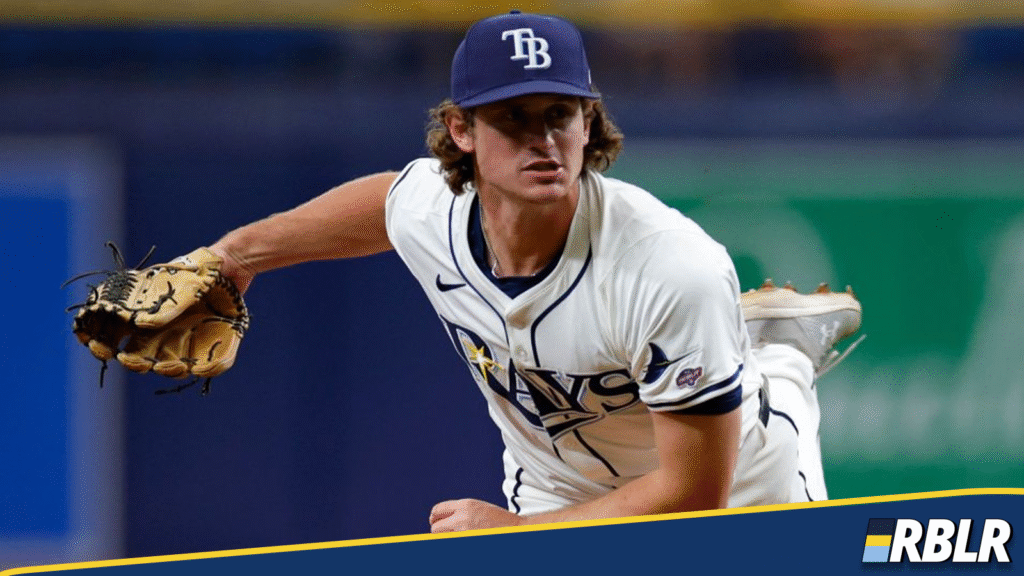
This week, our writers took a look at some of the numbers plaguing the recent bullpen struggles before turning their attention towards the draft beginning next weekend. Then, they wrap-up with a deep dive on what’s wrong with Mason Montgomery.
Jake Shutters (@JakeShutters) : The bullpen by the numbers
The Rays, no matter how good of baseball they have been playing over the past month, have run into a clear issue with their roster as currently constructed. The bullpen has imploded over the past month with a 5.17 ERA since 6/5 (25th in baseball), resulting in multiple losses and almost costing them a sweep at the hands of the A’s last week. Underperformance has been the root of these issues, and here are a few key statistics I believe show some of the reasons for this underperformance.
Mason Montgomery’s Meatball% (11.4%): Recently, Erik Neander had an interview with Evan Closky where he said while accessing Montgomery’s performance this season that, “To the extent that he has been hit is difficult for us to understand.” Montgomery may very well be the most talented pitcher in the bullpen, however his location woes have haunted him this year, causing his 19 IVB fastball to have a -8 run value this season. The league averages a .396 wOBA on “meatballs”, and the average meatball rate for pitchers is 7.1%. Montgomery throws the 2nd most meatballs in baseball among pitchers on a rate basis with at least 100 batters faced. Perhaps starting there could allow the Rays to figure out how Montgomery gets hit so much.
Pete Fairbanks’s K-BB% (11%): This development is one of the weirder ones when you think about where Fairbanks was a couple years ago. In 2023, Fairbanks had a 29.6% whiff rate on his 4-seam fastball and a 31.1 put away%. In 2025 thus far, he has a 22.7% whiff rate and a 15% put away% on the same pitch. He’s lost 3 IVB and 2 MPH on his fastball in the time between then and now, but him falling about 16% in K-BB is alarming by itself. Fairbanks finds himself around the 30th percentile amongst qualified relievers in K-BB%, which could be a problem come playoff time, assuming he is still your highest leverage situational reliever.
Edwin Uceta’s Hard-Hit% (45%): Uceta might be the biggest disappointment on the entire Rays team in 2025. Although he has looked a lot better in recent appearances, the overall body of work has been pretty atrocious this season, especially in giving up hard contact. In his breakout 2024, Uceta had an elite 31.2% Hard-Hit% and a 3.2% barrel rate. In 2025 those numbers have ballooned to a 45% hard hit rate (17th percentile) and a barrel rate that has more than quadrupled at 13%. The whiff and K numbers from last year are holding up, he’s throwing the ball in the zone at a career high rate, and the contact rates are similar to last year. The only large decrease in any statistic is a 16% decrease in infield fly ball percentage. Could it be a stretch of tough batted ball luck? The Rays will, unfortunately, have to just let it play out.
The unfortunate reality of the situation is that the three relievers listed above are accounting for 32% of the current bullpen’s usage and normally throw in medium to high leverage situations. With the deadline fast approaching, some interesting discussions may need to be had to ensure this bullpen can hold down games in the stretch run and hopefully in October.
Jacob Macauley (@raysfarmreport) : Potential 1st round targets
Two weeks ago, I briefly outlined the Rays draft situation and a player they may target due to his loud skills in the compensatory rounds. The Rays enter this draft with the 2nd largest bonus pool (only trailing Seattle), and their previous six first-round picks (including compensatory picks) have been bats (5 prep 1 college).
Marek Houston, almost certain to stick at SS, presents himself as one of my favorite options at 14. Houston had a tremendous season at Wake Forest, as he produced a 135 wRC+ and walked as much as he struck out (46/46). Power has always been his biggest question mark as a prospect, but he has raised his ISO from .087 as a freshman to .243 and flashed a 70th percentile max EV this previous season. Houston’s calling card is his plus shortstop defense and bat-to-ball skills (10.5% Z-Whiff% 83rd percentile).
Gavin Kilen presents himself as another option at number 14. Kilen is fresh off an extremely productive season at Tennessee, walking more than he struck out (30/27 BB/K) and sporting a 139 wRC+. Kilen also has some power concerns from scouts, garnering just a 45 future power grade, but like Houston, Kilen has also increased his ISO year over year to .314 this past season and also had an 84th percentile max exit velocity. Kilen defensively projects as a long-term plus 2nd basemen and a passable shortstop. These are the two college bats that intrigue me the most heading into pick number 14, and I am very excited to see what the Rays are able to do with their immense amount of flexibility heading into the draft.
Dustin Teuton (u/FLBoy19) : What’s wrong with Mason Montgomery?
It’s a thought that has entered my mind several times in the past few months. Mason Montgomery’s pure stuff is some of the best in baseball, via both pitch tracking and traditional benchmarks such as velocity. Among pitchers with 30 innings pitched, Mason is tied for first in all of baseball with an elite 123 fastball stuff+ (100 being average), his slider sits 8th at 132 stuff+, and is tied for 3rd in all MLB with a 127 overall stuff+ grade. Mason Montgomery has the pure stuff to dominate frame to frame as an MLB reliever. However, that hasn’t materialized. So far through 31 innings, he has posted a 5.23 ERA and his FIP sits at 3.93 (which is respectable for an MLB reliever’s rookie year). Expected numbers show signs of positive regression (4.02 xERA, 3.59 xFIP, and 3.45 SIERA).
The simple answer is command. His 12.1% walk rate is high but comparable to other successful hard-throwing relievers such as Mason Miller (12.2%) who has somewhat similar fastball velocity (100.9 vs 98.6) and generates the same amount of extension at 6.8 feet. There is also the general fact that 11% of his pitches have found the dead middle of the plate. But there is another answer if you dive deeper into Mason’s stats. The dude is just really unlucky. Mason being unlucky can first be seen in his FIP and SIERA (Almost two runs lower) being over a full run lower than his ERA, but it’s more pronounced than simple analytics. First, his BABIP sits at .359, which is way over the MLB average; second, he is only giving up a 39% hard-hit rate (67th percentile).
If you dig even deeper, Mason has given up a .295 BA (.338 wOBA) on all balls hit at or under 94mph exit velocity. That number continues to spike as you lower the threshold to under 90mph – it’s at .303. If you adjust for ideal line drive launch angle (10-25 degrees) with the caveat that hard hits are not included, Mason still gives up a .286 BA (.254 wOBA) balls hitter lower then 10 degrees, and a .250 BA (.222 wOBA) on balls hit with a 27 degree or higher launch angle. The wOBA for each shows that the contact quality is poor and has not led to extra base hits. Line drives in general provide a around a .620-.700 batting average which is similar to what Mason has allowed (.800), however Mason isn’t giving up a large number of line-drives his 16.5% LD rate is 42nd amongst 157 relief pitchers with 30+ innings.
Simply put, Mason’s struggles are tied to his command issues so far into his rookie year and the fact that an unusually high number of weak hit balls are finding a hole or falling against Mason Montgomery. For a pitcher who generates elite whiff rates (35%) and chase rates (33.6%), these numbers are slightly jarring. Mason’s stuff works, and although walks and general location issues are apparent, there is a core component that is needed as an MLB pitcher that Mason Montgomery has no control over, which is simply batted ball luck.
The RBLR Rays Roundtable is a weekly collection of analysis, insight, and perspectives from a cast of writers assembled because of their unique backgrounds and experience. Check this space weekly for new updates and features covering the Tampa Bay Rays, the Rays’ minor league prospects, and more!